A coastal resort wear brand owner from Nantucket called me in late August with a problem that was threatening her wholesale relationships. Her signature product was a beautiful, wide leather belt with a solid brass buckle. The buckle was the hero piece, a custom-designed, hand-polished brass plate with her brand’s logo deeply engraved. Her belts were sold in boutiques along the New England coast, in the Hamptons, in Martha’s Vineyard, and in Florida. Every one of those locations meant salt air. She had started receiving returns from retailers. The brass buckles, which had left our factory gleaming and golden, were arriving at the stores already dulled. Within weeks of being on display, they were developing a dull brown patina. Within months, some were showing the green-blue speckles of active corrosion. The retailers were losing confidence. The brand was losing its premium image. She needed to know why this was happening and how to stop it.
To avoid tarnishing on brass belt buckles after salt air exposure, you must apply a multi-layer protective strategy that begins with the brass alloy selection and ends with the post-manufacturing clear coating. The first defense is the brass composition itself. A brass alloy with a higher copper content, typically 70 percent copper and 30 percent zinc, called cartridge brass, is more resistant to corrosion than cheaper alloys with higher zinc content. The second defense is a high-quality clear protective lacquer or electrophoretic coating applied immediately after the final polishing step. This coating acts as a physical barrier between the brass surface and the corrosive salt air. The coating must be continuous, with no pinholes, no thin spots, and no scratches that expose the underlying metal. The third defense is proper packaging. The buckles should be packaged in anti-tarnish paper or film immediately after coating. The packaging should be sealed to prevent exposure to ambient humidity and airborne salt. The fourth defense is consumer education. The care instructions that accompany the belt should explain that brass is a living metal that will develop a natural patina over time, but that the clear coat should be maintained and that exposure to salt spray, sunscreen, and perspiration should be minimized and cleaned off promptly.
Brass tarnishing in coastal environments is a battle between a reactive metal and a corrosive atmosphere. The warm, humid, salt-laden air of a seaside resort is one of the most aggressive natural environments for brass. The salt particles, primarily sodium chloride, act as an electrolyte. When they settle on the brass surface, they dissolve in the ambient humidity, forming a conductive saltwater film. This film enables an electrochemical reaction between the copper and zinc in the brass alloy and the oxygen in the air. The copper corrodes, forming the dark brown and eventually green compounds we recognize as tarnish and verdigris. At AceAccessory, we produce brass belt buckles for brands that sell in coastal markets around the world. We have learned, through years of experience and materials testing, how to protect brass from salt air. Let me walk you through the science, the coatings, and the practical steps.
What Causes Brass to Tarnish in Coastal Environments
Brass is an alloy, a mixture of copper and zinc. The proportions of these two metals determine the brass’s color, its workability, and its corrosion resistance. Standard brass used for belt buckles is typically 65 to 70 percent copper and 30 to 35 percent zinc. Copper is a relatively noble metal. It does not corrode rapidly in clean, dry air. But it is highly susceptible to attack by chloride ions, the chemical component of sea salt. Zinc is a less noble metal. It corrodes more readily than copper, and in a salt air environment, it can leach out of the brass in a process called dezincification. This leaves behind a porous, weakened copper structure that is even more vulnerable to further corrosion.
Brass tarnishes in coastal environments because of an electrochemical corrosion process driven by salt, moisture, and oxygen. The salt particles in the air, primarily sodium chloride, settle on the brass surface. These particles are hygroscopic. They absorb moisture from the air. Even at moderate humidity levels, a thin film of saltwater forms on the metal surface. This film acts as an electrolyte, a conductive liquid that allows electrons to flow between different areas of the metal surface. The brass is not perfectly uniform. There are microscopic variations in composition between the copper-rich and zinc-rich areas. These variations create tiny anodes and cathodes, like a miniature battery. At the anodic areas, metal atoms lose electrons and dissolve into the electrolyte as ions. The copper ions react with chloride and oxygen to form copper chloride and copper oxide compounds. These compounds are the brown and black tarnish. The zinc ions also react, forming zinc oxide and zinc chloride. Over time, the copper compounds can further react with carbon dioxide and moisture to form copper carbonate, which is the distinctive green-blue patina known as verdigris. The process is accelerated by heat, which increases the rate of chemical reactions, and by the constant replenishment of salt from the sea breeze. The corrosion is not just a surface discoloration. It is an ongoing loss of metal. If left unchecked, it can pit the surface and eventually destroy the structural integrity of the buckle.
The rate of tarnishing depends on the concentration of salt in the air, the relative humidity, the temperature, and the specific brass alloy. A brass buckle in a sealed, air-conditioned inland store may remain bright for years. The same buckle in an open-air beachfront shop may tarnish in weeks. Let me detail the two most important chemical and environmental factors.
How Does Salt Air Accelerate the Corrosion of Brass?
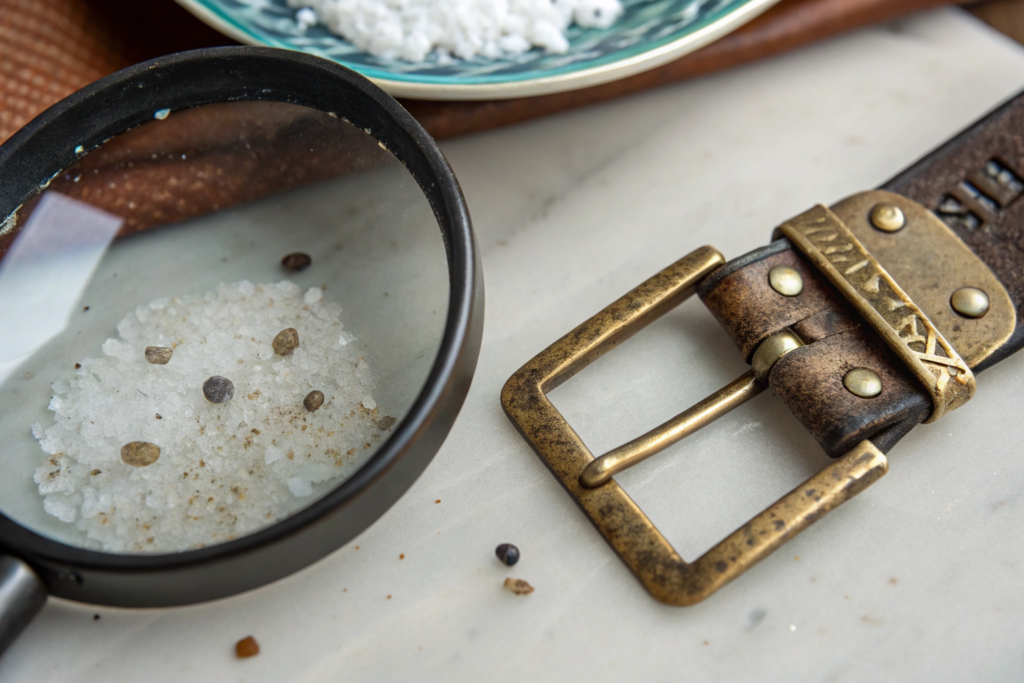
Salt air accelerates brass corrosion through a chemical cycle that is self-reinforcing. The process begins when microscopic salt particles become airborne. Waves crash, and tiny droplets of seawater are ejected into the atmosphere. The water evaporates, leaving behind tiny, invisible crystals of salt that are carried inland by the wind. These salt crystals settle on every exposed surface, including brass belt buckles. Sodium chloride is hygroscopic. At relative humidity above approximately 75 percent, it absorbs enough moisture from the air to form a liquid solution. This is the critical threshold. Below 75 percent relative humidity, the salt crystals remain dry, and corrosion is slow. Above 75 percent, a conductive liquid film forms, and corrosion accelerates dramatically. Coastal air is almost always above this threshold. The liquid film on the brass surface is not pure water. It is a concentrated salt solution, and it is highly conductive. It allows the electrochemical corrosion reactions to proceed rapidly. The chloride ions are particularly aggressive. They can penetrate and disrupt the thin, protective oxide layer that naturally forms on brass. This oxide layer, composed primarily of copper oxide, is what gives polished brass its long-term stability. Chloride ions attack this layer, pitting it and exposing fresh, reactive metal underneath. The corrosion becomes a cycle. The brass corrodes, forming tarnish. The tarnish is porous and does not protect the underlying metal. Salt continues to settle on the tarnished surface. The cycle repeats. The distance from the ocean is a major factor. The salt concentration in the air decreases exponentially with distance from the surf zone. A boutique directly on the boardwalk faces the most aggressive conditions. A boutique a mile inland faces significantly less salt exposure. The prevailing wind direction also matters. A location downwind of the ocean receives more salt than a location upwind.
What Is Dezincification and How Does It Affect Brass Buckles?
Dezincification is a specific form of corrosion that affects brass alloys with a zinc content above 15 percent. It is the selective leaching of zinc from the brass, leaving behind a porous, weakened copper structure. The zinc atoms, being less noble, more reactive, than copper, preferentially dissolve into the corrosive electrolyte. The copper atoms remain behind. The result is a surface that may still look somewhat like brass in color, because it is mostly copper, but it has lost its mechanical strength and its solidity. The affected area becomes spongy, brittle, and prone to cracking. Dezincification is a serious structural problem. It can cause a buckle to snap under load, a catastrophic failure for a functional belt. Dezincification is most aggressive in stagnant, acidic, or highly saline water. The thin saltwater film on a brass buckle exposed to coastal air provides exactly these conditions. The chloride ions in the salt attack the zinc preferentially. The rate of dezincification depends on the brass composition. Alpha brasses, with zinc content below 35 percent, are more resistant to dezincification. Alpha-beta brasses, with zinc content between 35 and 45 percent, are much more susceptible because the beta phase is zinc-rich and corrodes rapidly. Standard belt buckle brass is typically an alpha brass with 30 percent zinc. This provides a reasonable balance of workability, strength, and corrosion resistance. However, it is not immune to dezincification in aggressive coastal environments. The prevention of dezincification involves the same protective strategies as general corrosion prevention. A continuous, impermeable clear coating that isolates the brass from the salt air. There are also inhibited brasses that contain small amounts of arsenic, antimony, or phosphorus that dramatically reduce the rate of dezincification. These alloys, known as dezincification-resistant brasses, are more expensive but are specified for marine hardware and plumbing fittings. They are an option for premium belt buckles intended for coastal markets.
What Protective Coatings Prevent Brass Tarnish
The most effective defense against brass tarnishing is a physical barrier between the metal and the environment. This barrier is a clear coating that is applied to the polished brass surface after all manufacturing operations, polishing, engraving, and assembly, are complete. The coating must be transparent so that the beauty of the brass is visible. It must be continuous, with no pinholes, no thin spots, and no cracks. It must be durable, resistant to abrasion from handling, and flexible enough to move with the brass as it expands and contracts with temperature changes. And it must be chemically resistant to the oils, acids, and salts that it will encounter during the belt’s life, including perspiration, sunscreen, and atmospheric salt.
The protective coatings that prevent brass tarnish are clear lacquers and electrophoretic coatings. Clear lacquers are solvent-based or water-based polymer solutions that are sprayed or dipped onto the brass surface. The solvent evaporates, leaving a thin, hard, transparent film. Traditional nitrocellulose lacquers have been used for decades, but they can yellow over time and are not as durable as modern formulations. Acrylic lacquers are more durable and UV-resistant. They remain clear for years. Two-part polyurethane lacquers are the most durable. They are mixed just before application and cure by a chemical reaction to form a tough, abrasion-resistant film. Electrophoretic coating, also called e-coat or electrocoat, is a process where the brass buckle is immersed in a water-based bath containing charged polymer particles. An electric current is applied, and the particles are deposited uniformly onto the metal surface. The coated buckle is then baked to cure the coating. E-coat provides an exceptionally uniform, continuous coating, even on complex shapes with recesses and engravings. It is the premium protective finish for high-end brass accessories. The coating thickness is typically 5 to 15 microns. A thicker coating provides more protection but can start to look plastic-like and obscure the metal’s natural luster. The optimal thickness balances protection with aesthetics.
The choice of coating depends on the buckle’s design, the target price point, and the expected environmental exposure. A simple, smooth buckle can be effectively protected with a high-quality acrylic lacquer. An intricately engraved buckle with deep recesses benefits from the uniform coverage of e-coat. Let me detail the two most important coating options.
How Does a Clear Lacquer Protect Brass From Salt Air?
Clear lacquer protects brass from salt air by forming a continuous, impermeable film over the metal surface. The lacquer acts as a physical barrier. The salt particles settle on the lacquer, not on the brass. The moisture in the air is absorbed by the lacquer’s outer surface, but it cannot penetrate through to the metal. The electrochemical corrosion cycle is broken because there is no electrolyte bridging the brass surface. The lacquer must be perfectly continuous to be effective. A single pinhole in the lacquer film is a point of failure. Salt water can penetrate the pinhole, reach the brass, and initiate corrosion. The corrosion can then spread under the lacquer film, lifting it and exposing more metal. This is called underfilm corrosion, and it can be worse than no coating at all because the corrosion is hidden until the lacquer flakes off. The application process for clear lacquer is critical. The brass surface must be absolutely clean and free of oils, polishing compounds, and fingerprints before the lacquer is applied. Any contamination will prevent the lacquer from adhering, and it will peel. The surface is cleaned with a solvent degreaser, often acetone or a specialized pre-paint solvent. The lacquer is applied in a dust-free environment. Dust particles landing on the wet lacquer create pinholes. The lacquer is applied in multiple thin coats rather than one thick coat. Thin coats dry more evenly and are less prone to sagging, bubbling, and pinholes. The lacquer is cured according to the manufacturer’s specifications. Under-cured lacquer is soft and easily damaged. Over-cured lacquer can become brittle and crack. The finished coated buckle is inspected under a bright light for any visible defects in the coating. A pinholiday detector, an electrical instrument, can be used to test for microscopic discontinuities. A coated brass buckle with a properly applied, high-quality acrylic or polyurethane lacquer can remain bright and tarnish-free for years, even in coastal environments.
What Is Electrophoretic Coating and When Is It Used?
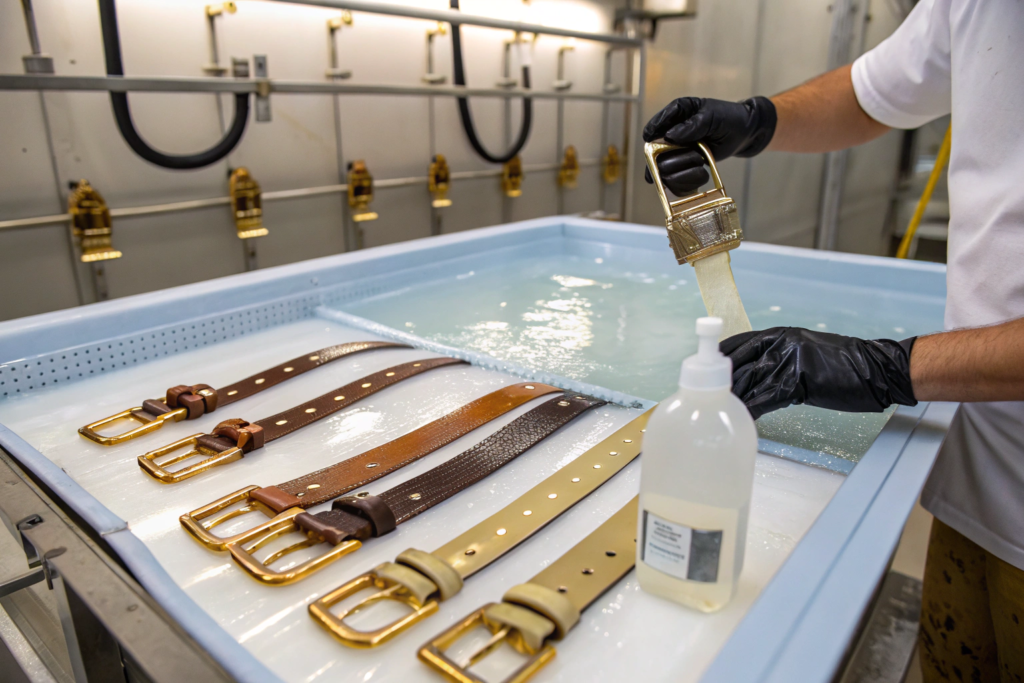
Electrophoretic coating, commonly called e-coat, is a premium finishing process that provides the highest level of corrosion protection for metal accessories. It is the same technology used to protect automotive body panels, which must withstand years of exposure to rain, road salt, and UV radiation. The process works by electrodeposition. The brass buckle is immersed in a water-based bath containing the coating material, which consists of charged polymer particles, pigments, and additives. The buckle is connected to an electrical circuit as one electrode. A counter-electrode is placed in the bath. When a direct current is applied, the charged polymer particles migrate through the water and deposit onto the brass surface. The coating builds up as a uniform, continuous film. Because the deposition is driven by the electric field, the coating reaches every surface that is in contact with the bath liquid. It penetrates into recesses, engraving grooves, and the inside of hollow parts. Areas that are impossible to coat uniformly with spray lacquer are coated perfectly with e-coat. After deposition, the coated buckle is removed from the bath, rinsed to remove any residual bath liquid, and baked in an oven. The heat cures the coating, cross-linking the polymer chains into a tough, durable film. The resulting coating is highly resistant to corrosion, chemicals, and abrasion. It is typically 15 to 25 microns thick, slightly thicker than a spray lacquer, but it is so uniform that it is almost invisible. The brass color and luster are preserved. E-coat is used for premium belt buckles that will be exposed to harsh environments, including coastal resorts, marine applications, and outdoor work. It is more expensive than spray lacquer because of the equipment and the process control required, but the performance is superior. The e-coat process is also environmentally friendly. The water-based bath contains very low levels of volatile organic compounds, unlike solvent-based spray lacquers. The overspray is eliminated, and the bath is continuously filtered and recycled.
What Packaging and Storage Methods Reduce Tarnish Risk
The protective coating is the primary defense against tarnish, but packaging and storage provide the secondary defense. The period between the factory and the consumer can be weeks or months. The buckle is shipped, stored in a warehouse, displayed on a retail shelf, and possibly stored again by the consumer. During all of this time, it is exposed to ambient humidity and airborne contaminants. Packaging that is designed to prevent tarnish can significantly extend the bright life of a brass buckle. The packaging materials absorb or neutralize the corrosive agents, the moisture, the sulfur compounds, and the salt, that cause tarnish. The packaging also provides a physical barrier against handling, which can transfer skin oils and salts to the coated surface.
The packaging and storage methods that reduce tarnish risk for brass belt buckles are anti-tarnish paper and film, desiccant packs, and sealed barrier packaging. Anti-tarnish paper is a specialty paper that is impregnated with activated carbon or with volatile corrosion inhibitors, VCIs. The paper absorbs hydrogen sulfide, sulfur dioxide, and other tarnish-causing gases from the air. Strips of this paper are placed inside the packaging with the brass buckle. Anti-tarnish film is a polyethylene or polypropylene film that contains a VCI. The inhibitor slowly volatilizes and fills the interior of the sealed package, depositing a microscopic, invisible protective layer on the brass surface. The film is used to make the bags or the wrappers that directly contact the buckle. Desiccant packs are small sachets of silica gel or clay that absorb moisture from the air inside the sealed package. Keeping the relative humidity below 40 percent dramatically slows the corrosion rate. The desiccant packs are placed inside the sealed bag with the buckle. Sealed barrier packaging is the final step. The buckle, wrapped in anti-tarnish paper or film, with a desiccant pack, is placed inside a bag made from a material with low moisture and gas permeability, such as a metalized polyester film. The bag is heat-sealed, creating a hermetic micro-environment. The sealed bag is then placed inside the retail packaging, the gift box or the display card. The sealed barrier packaging protects the buckle from the moment it leaves the factory until the moment the consumer opens it. For retail display, a small sign or a note in the packaging can advise the retailer to keep the buckle in its sealed bag until it is placed on display, and to store backup inventory in a cool, dry place.
The cost of anti-tarnish packaging is modest, a few cents per unit. The cost of a tarnished buckle returned by a retailer or a consumer is far greater. Let me detail the two most important packaging materials.
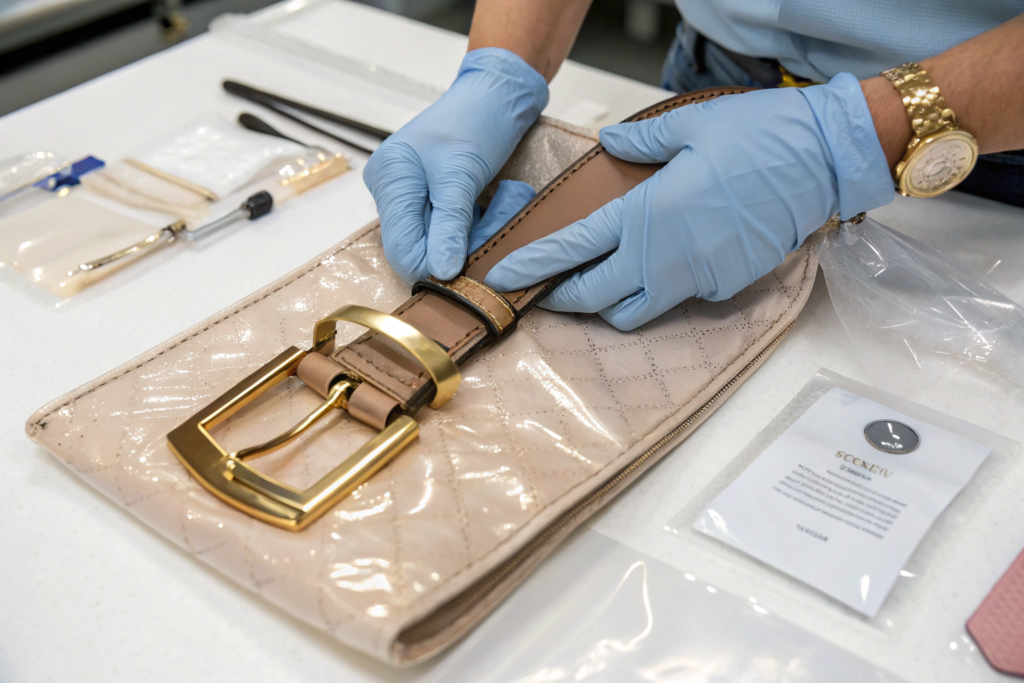
How Do Anti-Tarnish Strips Work Inside Packaging?
Anti-tarnish strips are small pieces of paper or film that are impregnated with chemicals that protect metal from tarnish. There are two main types. Activated carbon strips and vapor phase inhibitor strips. Activated carbon strips work by absorption. The carbon has an enormous internal surface area, one gram of activated carbon can have a surface area of over 1,000 square meters. This surface attracts and traps gas molecules through a process called adsorption. The carbon absorbs hydrogen sulfide, sulfur dioxide, carbonyl sulfide, and other airborne pollutants that cause tarnish. By removing these gases from the air inside the packaging, the carbon strip prevents them from reaching the brass surface. Activated carbon strips are effective for general tarnish prevention. Vapor phase inhibitor strips work by emitting a protective vapor. The strip is impregnated with a chemical, typically an amine salt or a triazole compound, that slowly volatilizes at room temperature. The vapor fills the enclosed space of the packaging. The inhibitor molecules are attracted to the metal surface, where they form a microscopic, invisible layer that blocks the corrosive reaction. The VCI layer is only a few molecules thick, and it does not change the appearance of the brass. When the package is opened, the VCI vapor dissipates, and the protective layer gradually evaporates. The metal is left clean and bright. VCI strips are highly effective for protecting brass, copper, and silver. They are available in different formulations for different metals. The strips are placed inside the sealed package with the buckle. One small strip, typically 2.5 by 5 centimeters, is sufficient for a small package. The strips are non-toxic and safe for use with consumer products. They are also effective at preventing tarnish on any other metal components of the belt, such as the buckle prong, the rivets, or any decorative studs.
Should Brass Buckles Be Stored in Sealed Polybags?
Yes, sealed polybags are the most effective packaging format for preventing tarnish during storage and transit. The sealed bag creates a micro-environment around the buckle that isolates it from the external atmosphere. The humidity, the salt, and the pollutants that cause tarnish are kept outside. The sealed bag also allows the anti-tarnish strips and desiccant packs to work at maximum efficiency. If the package is open to the atmosphere, the VCI vapor escapes, and the desiccant is quickly overwhelmed by ambient humidity. In a sealed bag, the VCI vapor is contained, and the desiccant only needs to absorb the small amount of moisture trapped inside the bag at the time of sealing. The bag material should have low gas and moisture permeability. Standard polyethylene bags are too permeable. They allow oxygen, water vapor, and sulfur-containing gases to pass through over time. A better choice is a metalized polyester film, often called Mylar, which has a thin aluminum coating that provides an excellent gas barrier. A polypropylene film is also a good barrier and is less expensive. The bag should be heat-sealed after the buckle, the anti-tarnish strip, and the desiccant pack are placed inside. The seal must be continuous and free of wrinkles or gaps. A poor seal is worse than no seal because it gives the illusion of protection. The sealed bag is then placed inside the retail packaging. The consumer receives the buckle in pristine, tarnish-free condition. The care instructions can suggest that the consumer store the buckle in the sealed bag when not in use, especially if they live in a coastal area. The sealed bag, combined with a desiccant pack and an anti-tarnish strip, is the gold standard for tarnish prevention during the supply chain journey.
How Should Consumers Care for Brass Buckles in Salt Air
The best protective coating and the best packaging in the world cannot protect a brass buckle indefinitely once it is in the consumer’s hands. The consumer wears the belt. The buckle is exposed to salt air, to perspiration, to sunscreen, to rain, and to the oils of the skin. The consumer is the final steward of the buckle’s finish. Educating the consumer about how to care for their brass buckle is a valuable brand service. It extends the life of the product, enhances the consumer’s satisfaction, and reduces the likelihood of returns or complaints about tarnish. The care instructions should be clear, simple, and encouraging. They should emphasize that brass is a living metal that develops character over time, but that simple care will keep it looking its best.
Consumers can care for brass belt buckles in salt air environments by following a simple routine. After each wear, especially in hot, humid, or coastal conditions, the buckle should be wiped gently with a soft, dry, clean cloth. This removes any salt residue, perspiration, and skin oils before they can react with the brass. Microfiber cloths are ideal because they are soft, non-abrasive, and highly absorbent. The buckle should be stored in a cool, dry place. A drawer or a closet is better than a bathroom, which is often humid. The buckle should not be stored in direct contact with leather that has been treated with acidic conditioners or with other metals that could cause galvanic corrosion. If the clear coating becomes scratched or worn, exposing the raw brass, a small amount of a high-quality brass polish can be applied to the affected area, following the polish manufacturer’s instructions. The polish should be used sparingly and only when needed, because it removes a microscopic layer of metal each time it is used. After polishing, the area should be cleaned and, if possible, resealed with a clear metal lacquer available at hardware stores. The consumer should avoid exposing the buckle to salt water, chlorinated pool water, and harsh chemicals. If the buckle does get wet with salt water, it should be rinsed with fresh water as soon as possible and dried thoroughly. The care instructions that accompany the belt should be written in a friendly, helpful tone. They should not alarm the consumer or imply that the product is fragile. They should present care as a natural part of owning a quality item, like conditioning leather boots or oiling a wooden cutting board.
The care instructions are an opportunity to build a relationship with the consumer. A small card with the brand’s story and the care tips adds value and reinforces the brand’s commitment to quality. Let me detail the two most important care practices.
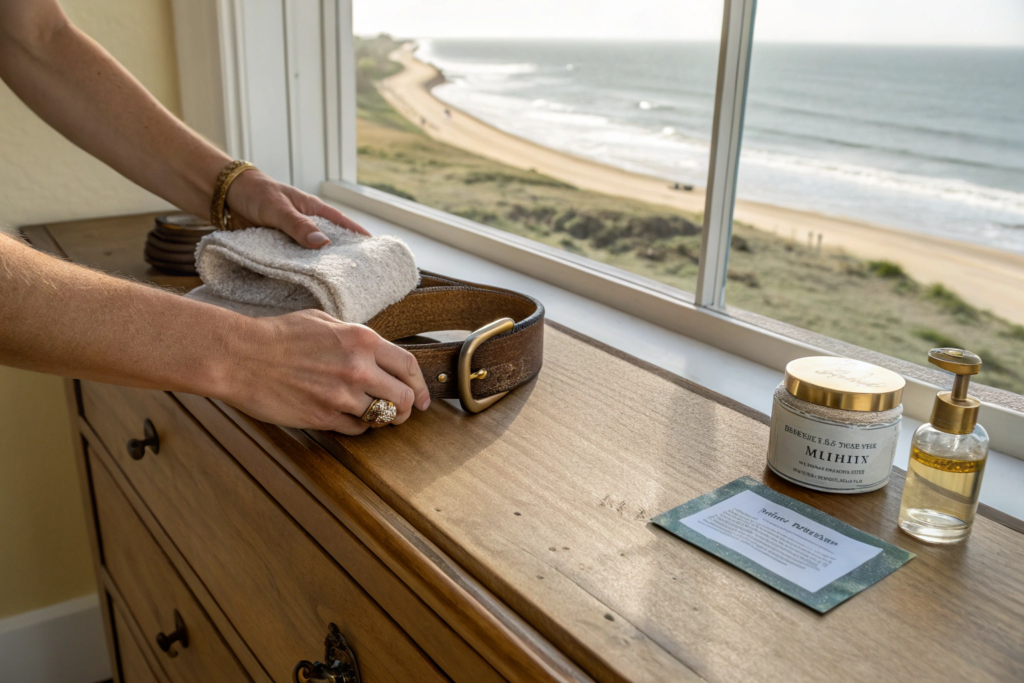
How Often Should Brass Be Polished in Humid Coastal Climates?
The polishing frequency for a brass belt buckle in a coastal climate depends on the quality of the protective coating and the intensity of the exposure. A buckle with an intact, high-quality e-coat or polyurethane lacquer should not need polishing at all. The coating protects the brass, and polishing would damage the coating. The consumer should be instructed not to polish a coated buckle. The care for a coated buckle is simply wiping it clean with a dry cloth. A buckle that has lost its coating, or that was sold with an uncoated, raw brass finish as a design choice, will develop a patina. The patina is a natural, gradual darkening of the brass that many people find attractive. It gives the brass a warm, antique character. If the consumer prefers to maintain a bright, polished look, they will need to polish the buckle periodically. In a coastal environment, with daily wear, an uncoated brass buckle may need polishing every two to four weeks to maintain a bright finish. The polishing frequency is determined by observation. The consumer should polish the buckle when it no longer looks the way they want it to look. When polishing, a small amount of a quality brass polish should be applied to a soft cloth, not directly to the buckle. The cloth is rubbed gently over the brass surface in a circular motion. The polish is allowed to dry to a haze, and then it is buffed off with a clean portion of the cloth. The buckle should be wiped thoroughly to remove all polish residue. Over-polishing can wear down engraved details and remove metal. The consumer should polish only as often as necessary to maintain the desired appearance. A polishing routine is something many consumers find satisfying. It is a moment of care and attention for a valued possession.
What Cleaning Products Are Safe for Coated Brass Buckles?
Coated brass buckles require gentle cleaning. The clear coating is a plastic film, and it can be damaged by harsh chemicals, abrasive cleaners, and rough cloths. The only cleaning product needed for routine care is a soft, dry, clean cloth. A microfiber cloth is ideal. The cloth is used to wipe the buckle gently after each wear. This removes any surface contaminants, salt, sweat, and dust. If the buckle is visibly dirty, the cloth can be slightly dampened with clean water. The water should be applied to the cloth, not directly to the buckle. The buckle is wiped gently, and then immediately dried with a dry portion of the cloth. No soap, detergent, or chemical cleaner should be used. Soap can leave a film that dulls the coating. Detergents can be alkaline and can attack the coating or the underlying brass. Solvents, including alcohol, acetone, and paint thinners, must never be used. They will dissolve many clear coatings. The consumer should be warned that many common household products, including window cleaners, all-purpose cleaners, and even some hand sanitizers, contain solvents that can damage the clear coat. If the buckle comes into contact with any of these, it should be rinsed immediately with clean water and dried. Abrasive cleaners, including baking soda, toothpaste, and scouring powders, must never be used on a coated buckle. They will scratch and dull the coating, creating a haze that cannot be removed. The care instructions should include a clear list of what to avoid. The message is simple. A coated brass buckle needs only a gentle wipe with a dry cloth. Nothing more.
Conclusion
Preventing tarnish on brass belt buckles exposed to salt air is a challenge that spans material science, surface engineering, and consumer education. The salt-laden breeze of a coastal resort is an aggressive corrosive environment that attacks brass through an electrochemical cycle driven by chloride ions, moisture, and oxygen. The defense is a multi-layered system. It begins with the brass alloy itself, choosing a composition with good corrosion resistance. It centers on the protective coating, a high-quality clear lacquer or electrophoretic coating that forms a continuous, impermeable barrier between the metal and the environment. It is reinforced by the packaging, the anti-tarnish strips, the desiccant packs, and the sealed barrier bags that protect the buckle during its journey from factory to consumer. And it is sustained by the consumer, who, guided by simple care instructions, maintains the buckle’s finish through gentle cleaning and proper storage. No single layer of this defense is sufficient on its own. The alloy resists corrosion but will tarnish without a coating. The coating protects but needs the clean surface beneath it. The packaging preserves the finish but ends when the package is opened. The consumer maintains the finish but needs the right information. The layers work together.
At AceAccessory, we produce brass belt buckles for brands that sell in every environment, from the arid desert to the humid tropics to the salt-sprayed coast. We understand the material requirements and the coating technologies that are appropriate for each. Our brass suppliers provide certified alloy compositions. Our finishing department applies clear coatings with precision and inspects them rigorously. Our packing team uses anti-tarnish materials and sealed packaging for every brass product we ship. We provide our brand clients with care instruction templates that they can customize for their own brand voice.
If you are sourcing brass belt buckles, or any brass accessories, for sale in coastal markets or for consumers who demand long-lasting beauty, I invite you to contact us. Reach out to our Business Director, Elaine, at elaine@fumaoclothing.com. Tell her about your product, your target market, and any tarnish-related issues you have experienced. She can provide samples of our coated brass finishes, discuss coating options for different environments, and provide a quotation for production. Let us help you create brass accessories that stay beautiful, season after season, even in the salt air.