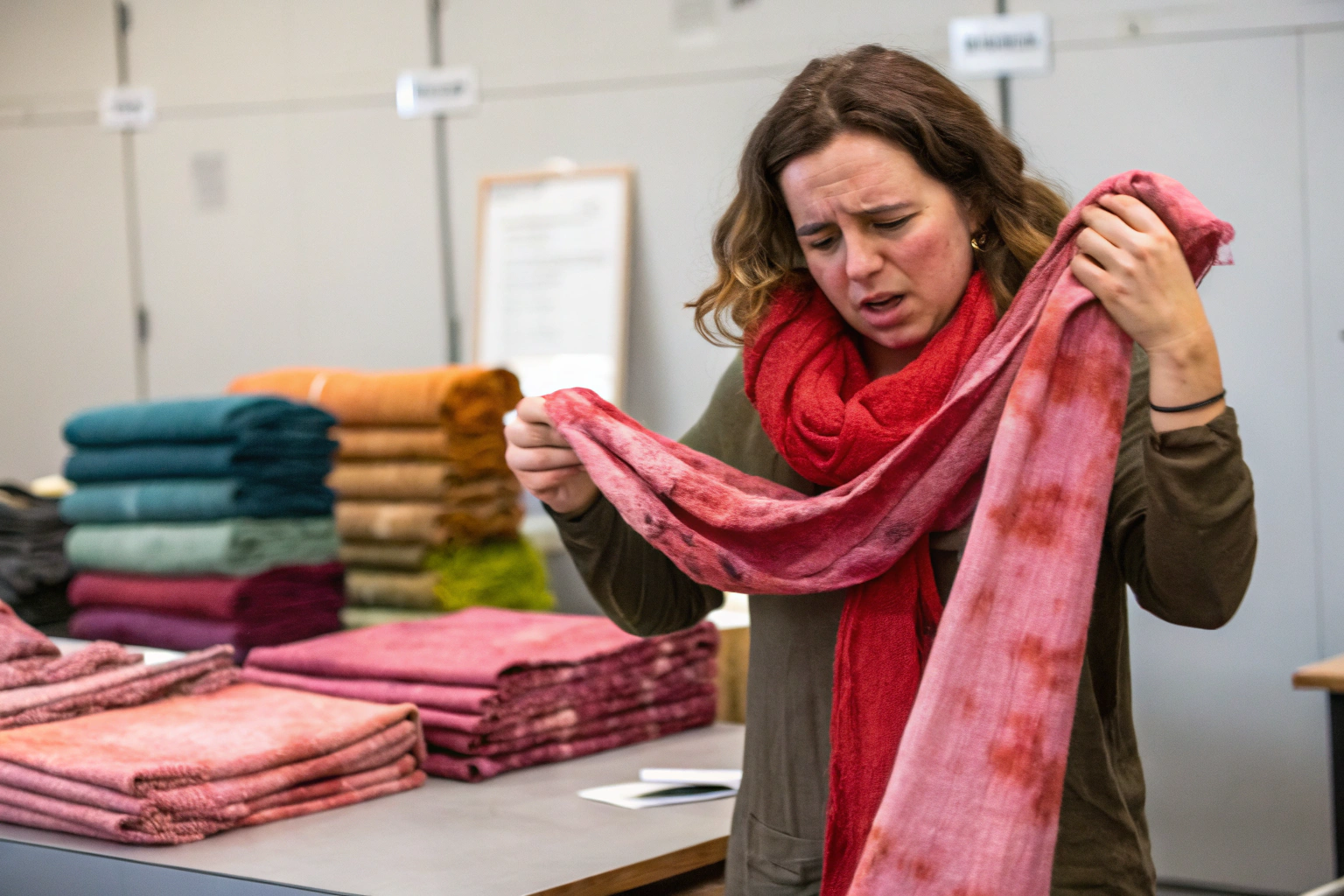
A sustainable fashion brand owner from Amsterdam called me two years ago, and I could hear the distress in her voice. She had just received an email from a customer. The customer had purchased a beautiful crimson red scarf from her online store, a 100% organic cotton voile, dyed with what the brand marketed as "low-impact, eco-friendly dyes." The customer had hand-washed the scarf in cold water, as the care label instructed. When she lifted the scarf from the basin, the water was bright red, and the scarf was now a patchy, faded pink. The customer had taken photographs. She had posted them on social media. The post was gaining traction. The brand’s commitment to quality and sustainability was being questioned publicly. The brand owner had tested the scarf herself. The color had bled. The entire production batch, 800 scarves in various colors, was now suspect. She needed to understand what had gone wrong and how to ensure it never happened again.
To avoid color bleeding on red scarves during the first wash, you must address the dye chemistry, the dyeing process, and the post-dye washing at the production stage. Red dyes, particularly reactive reds and direct reds used on cotton and viscose, are among the most challenging colors to fix completely because the red dye molecule is relatively large and has a lower fixation rate than other colors. The solution begins with selecting a high-fixation, bifunctional reactive dye specifically formulated for deep red shades. The dyeing process must be precisely controlled, temperature, pH, salt concentration, and time, to maximize the covalent bond between the dye and the fiber. The post-dye washing, called the soaping-off process, must be thorough and multi-stage, using hot water, specialized soaping agents, and multiple rinse cycles to remove every trace of unfixed, hydrolyzed dye that would otherwise bleed into the wash water. Finally, the finished scarves should be tested for color fastness to washing using the ISO 105-C06 or AATCC 61 standard before they are approved for shipment. A factory that shortcuts the soaping-off process to save water, energy, or time will produce scarves that bleed.
Red is the most difficult color in the textile spectrum. It is not your imagination that red garments bleed more than blue or green. The chemistry of red dyes makes them inherently more challenging to fix to the fiber and more prone to bleeding during washing. At AceAccessory, we produce scarves in every color, and our dyeing team has developed specific protocols for red and other high-bleed-risk colors. These protocols are more expensive, more time-consuming, and more resource-intensive than standard dyeing, but they are non-negotiable because a scarf that bleeds is not a finished product. It is a liability. Let me walk you through the chemistry, the process, and the testing that prevents color bleeding on red scarves.
Why Does Red Dye Bleed More Than Other Colors
Understanding why red dye bleeds requires a brief journey into textile chemistry, but I will keep it practical. The dyes used to color cellulose fibers like cotton, viscose, bamboo, and modal are called reactive dyes. They are called reactive because they chemically react with the fiber to form a covalent bond. The dye molecule attaches itself to the cellulose molecule, becoming part of the fiber. This is why a well-dyed cotton scarf can be washed repeatedly without significant fading. The dye is not sitting on the surface. It is chemically bonded to the fiber. The problem is that this bonding reaction is not 100 percent efficient. A portion of the dye does not bond with the fiber. Instead, it reacts with water in the dye bath, a process called hydrolysis. The hydrolyzed dye is chemically similar to the bonded dye, and it has a strong affinity for the fiber. It sticks to the fiber surface, but it is not bonded. It is just sitting there, waiting to be washed away.
Red dyes bleed more than other colors because of the specific chemistry of red reactive dye molecules. Red dyes typically have a larger molecular structure than blue, yellow, or black dyes. The larger molecule is more difficult to diffuse into the tightly packed crystalline regions of the cellulose fiber, resulting in a lower fixation rate. Where a blue reactive dye might achieve a fixation rate of 85 to 90 percent, a deep red reactive dye might only achieve 70 to 80 percent. This means 20 to 30 percent of the expensive red dye becomes hydrolyzed waste that must be washed out of the fabric. This hydrolyzed dye is what bleeds. Red dyes also have a high substantivity, meaning a strong physical attraction to the fiber surface. The hydrolyzed red dye clings tenaciously to the cotton. It requires more aggressive soaping, higher temperatures, more detergent, and more rinse cycles to remove it completely. If the soaping process is cut short, the hydrolyzed dye remains on the scarf. When the customer washes the scarf for the first time, the hydrolyzed dye releases into the water, and the bleeding is spectacular. The problem is compounded by the fact that red is often dyed at very high depths of shade, a high concentration of dye relative to the fabric weight, to achieve a rich, deep crimson or scarlet. More dye in the bath means more hydrolyzed dye to remove.
The combination of lower fixation, high substantivity, and high depth of shade makes red the perfect storm for color bleeding. Other challenging colors include turquoise, which has a very large dye molecule, and deep navy, which is dyed at high depths. But red is consistently the most problematic. Let me explain the two critical chemical factors in more detail.
What Is the Difference Between Reactive and Direct Dyes for Scarves?
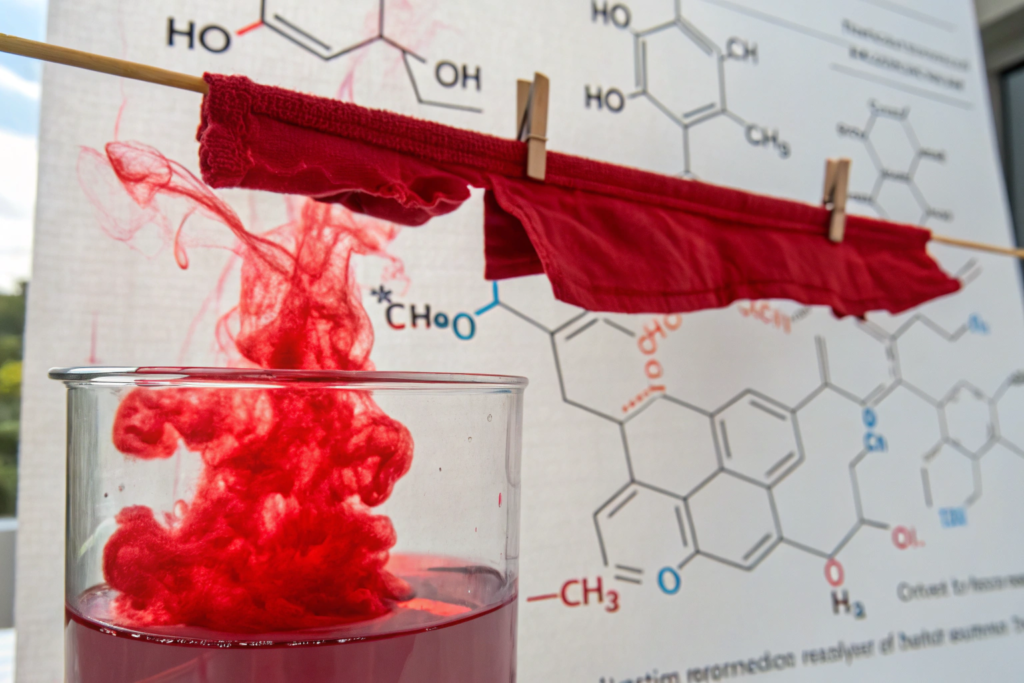
Reactive dyes and direct dyes are the two main classes of dyes used for cellulose fibers like cotton and viscose. They are fundamentally different in how they attach to the fiber, and this difference has profound implications for color fastness. Reactive dyes form a covalent chemical bond with the cellulose molecule. The dye molecule contains a reactive group, typically a vinyl sulfone or a monochlorotriazine, that reacts with the hydroxyl groups on the cellulose under alkaline conditions and elevated temperature. The bond is strong, permanent, and resistant to washing. A properly dyed and soaped reactive-dyed scarf will have excellent wet fastness. The dye will not bleed during normal home laundering. Reactive dyes are the standard for quality scarves and apparel. Direct dyes, also called substantive dyes, do not form a chemical bond. They attach to the fiber through weaker physical forces, hydrogen bonding and van der Waals forces. The dye molecule has a flat, linear shape that allows it to lie along the cellulose chain and stick to it. The attachment is reversible. Direct dyes have inherently poor wet fastness. They will bleed during washing, especially in warm or hot water. Direct dyes are used for products where wet fastness is not critical, such as paper, or for very cheap textiles where cost is the primary driver. For a quality scarf, especially a red scarf, reactive dyes are the only acceptable choice. The dyeing process is more expensive, the chemicals are more complex, and the soaping is more demanding, but the result is a scarf that will not bleed. When we produce scarves for our brand clients, we specify reactive dyes exclusively. We document the dye class in the technical file for each product. A buyer who is concerned about color bleeding should ask the factory to specify the dye class on the purchase order and to provide evidence that reactive dyes were used.
How Does the Dye Fixation Rate Affect Bleeding Risk?
The fixation rate is the percentage of the dye applied to the fabric that actually forms a permanent bond with the fiber. The remainder is hydrolyzed and must be washed out. The fixation rate is the single most important number in understanding bleeding risk. A typical bifunctional reactive dye, one with two reactive groups per molecule, has a fixation rate of 80 to 95 percent depending on the color, the depth of shade, and the dyeing conditions. A deep red might fix at 75 to 85 percent. A deep black, which is a mixture of colors, might fix at 70 to 80 percent. A light pastel might fix at 90 to 95 percent. The lower the fixation rate, the more hydrolyzed dye must be removed in the soaping process. If 20 percent of the dye is unfixed, that means for every kilogram of fabric dyed to a 4 percent depth of shade, 40 grams of dye per kilogram of fabric, 8 grams of dye per kilogram of fabric must be washed out. For a production batch of 200 kilograms of scarves, that is 1.6 kilograms of hydrolyzed red dye that must be removed. The soaping process must be designed to handle this load. The fixation rate can be improved through several means. Using a bifunctional reactive dye, with two reactive groups, increases the probability of bond formation. Optimizing the dyeing conditions, the temperature profile, the electrolyte concentration, and the alkali dosing, maximizes the reaction rate and minimizes hydrolysis. Using a high-quality, well-purified dye with minimal inactive isomers ensures that the dye molecules present are capable of reacting. We work closely with our dye supplier to select the highest fixation red dyes available, and our dyeing technicians continuously monitor and optimize the dyeing parameters to achieve the highest possible fixation. Every dye lot is checked for shade and for unfixed dye content before the fabric moves to soaping.
What Production Processes Prevent Color Bleeding
Preventing color bleeding on red scarves is not a single action. It is a sequence of processes, each of which must be executed correctly. A failure at any stage, dye selection, dyeing control, or soaping, will result in a scarf that bleeds. The production process for a color-fast red scarf is more expensive and more time-consuming than for a less demanding color. The dyeing cycle is longer. The soaping cycle uses more water, more energy, and more chemicals. The quality control testing is more rigorous. A factory that competes on price alone will be tempted to shortcut these processes. A factory that competes on quality will not.
The production processes that prevent color bleeding on red scarves are dye selection, controlled dyeing, and thorough soaping. Dye selection involves choosing a high-fixation, bifunctional reactive dye with good wash-off properties. The dye should be specifically recommended by the supplier for deep red shades and should have documented fastness properties. Controlled dyeing involves precisely managing the dye bath parameters, temperature ramp rate, electrolyte addition, alkali dosing, and dwell time, to maximize the fixation rate and minimize hydrolysis. The dyeing cycle for reactive dyes is typically 4 to 6 hours for a deep red shade. Thorough soaping is the most critical process for bleeding prevention. It involves draining the exhausted dye bath, rinsing the fabric in cold water to remove loose surface dye, soaping at high temperature, 90 to 95 degrees Celsius, with a specialized soaping agent that disperses and suspends the hydrolyzed dye, multiple hot rinse cycles, and a final cold rinse. The soaping process can take 2 to 4 hours for a deep red shade. The completion of soaping is verified by a clear rinse water test, where the final rinse water is visually clear and shows no trace of color. After soaping, the fabric is dried and then tested for color fastness to washing.
The investment in proper soaping is significant. It consumes large volumes of water, which must be heated to near boiling. It requires specialized chemicals. It takes production time. The cost of soaping a deep red scarf is substantially higher than the cost of soaping a pale blue scarf. This is why red scarves often carry a slightly higher price from quality factories. Let me detail the soaping process and the after-treatment options.
How Does the Soaping Process Remove Unfixed Dye?
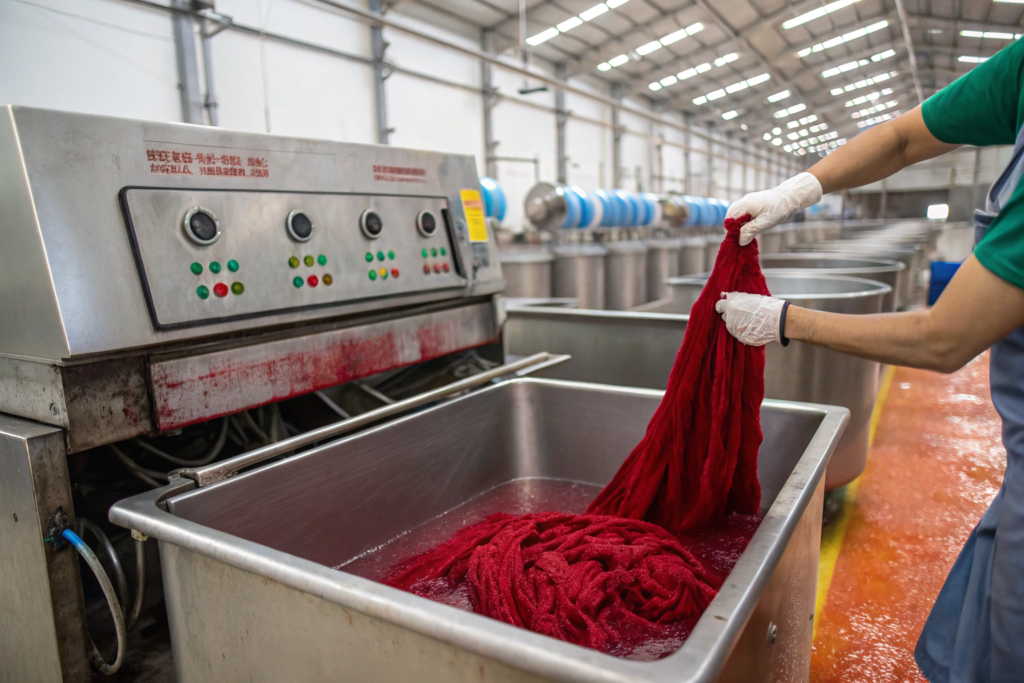
Soaping is the critical wash-off process that removes hydrolyzed, unfixed dye from the fabric. It is not simply rinsing the fabric. It is a chemical engineering process that uses heat, detergency, and mechanical action to dislodge the tenaciously adhering hydrolyzed dye molecules. The process begins immediately after the dyeing cycle is complete. The exhausted dye bath, which contains the remaining chemicals and some hydrolyzed dye, is drained. The fabric is given a cold rinse to remove the bulk of the alkali and salt. This is important because residual alkali can cause the dye to continue reacting and hydrolyzing during the soaping process. The cold rinse is quick, a few minutes. The main soaping stage follows. The dyeing machine is filled with fresh water and heated to 90 to 95 degrees Celsius. A soaping agent is added. The soaping agent is a specialized surfactant, often a non-ionic detergent or a polymeric dispersant, designed to do two things. It wets the fabric and penetrates the fiber structure to lift the hydrolyzed dye from the surface. And it forms micelles, tiny molecular cages, around the hydrolyzed dye molecules in the water, preventing them from redepositing onto the fabric. Without the soaping agent, the hydrolyzed dye would simply float around in the hot water and reattach to the fabric. The soaping agent keeps the dye suspended in the water so it can be drained away. The fabric is circulated in the hot soaping solution for 15 to 30 minutes. The solution turns deep red as the hydrolyzed dye is removed. The soaping solution is drained. The process is repeated, a second soaping cycle, often at a slightly lower temperature, to remove any remaining dye. The number of soaping cycles depends on the depth of shade and the dye. A deep red may require three or even four soaping cycles. After soaping, the fabric is rinsed in hot water, then warm water, then cold water, to progressively cool the fabric and remove any residual soaping agent. The final rinse water is visually inspected. It must be completely clear. If any tint of color is visible, the soaping is not complete, and additional cycles are run.
What Fixatives Can Be Applied After Dyeing Red Scarves?
After soaping, an optional but highly recommended step is the application of a dye fixative, also called a cationic fixative or an after-treatment agent. The fixative is a colorless compound, typically a quaternary ammonium polymer, that is applied to the fabric in a final wet processing step. The fixative molecules are attracted to the residual hydrolyzed dye that may still be present in trace amounts within the fiber, despite the most thorough soaping. The fixative forms a large, insoluble complex with the dye molecule. The complex is too large to migrate out of the fiber during washing. The fixative essentially locks the residual dye in place. The application of a fixative can dramatically improve the wet fastness of a red scarf, often by one to two points on the standard gray scale for staining. The fixative is applied after soaping, typically in a separate bath at a moderate temperature, 40 to 60 degrees Celsius, for 15 to 20 minutes. The fabric is then dried without rinsing, as the fixative is designed to remain on the fabric. The choice of fixative is important. Some fixatives can affect the hand feel of the fabric, making it stiffer or harsher. Some can cause yellowing over time, particularly with exposure to heat or light. Some are not compatible with certain fabric finishes. We use a formaldehyde-free, non-yellowing cationic fixative specifically designed for reactive-dyed cellulose fabrics. It is applied at a low concentration, typically 1 to 3 percent on weight of fabric, to minimize any effect on hand feel. The fixative is an insurance policy. It provides an additional margin of safety against bleeding. For deep red scarves, we strongly recommend the use of a fixative. The incremental cost is small, and the improvement in wet fastness is significant. The fixative treatment is documented in the production records and is part of our standard protocol for high-bleed-risk colors.
What Testing Confirms a Red Scarf Will Not Bleed
Testing is the proof that the production processes have worked. A visual inspection of a dry scarf cannot determine whether it will bleed when washed. The bleeding only becomes visible when the scarf is wet and in contact with water and other fabrics. Standardized wash fastness testing simulates home laundering in a controlled, repeatable way, and it provides objective, numerical results that can be compared against specifications. Testing should be performed on every production batch of red scarves, not just on a one-time prototype. The test results should be documented and included in the shipment quality documentation.
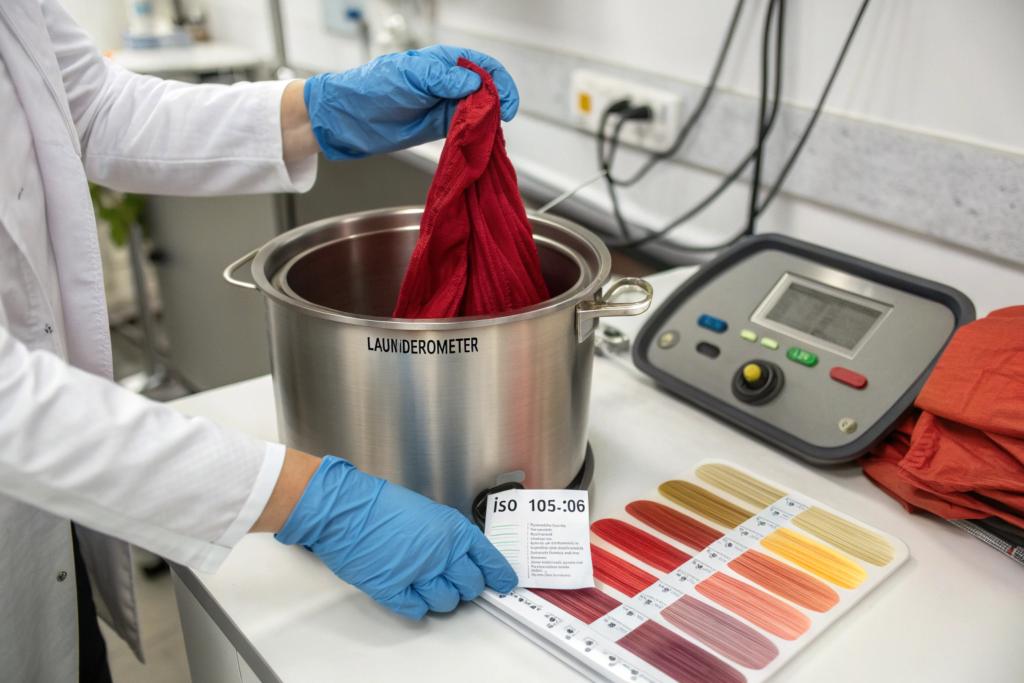
The standard test for confirming a red scarf will not bleed is ISO 105-C06, the international standard for color fastness to domestic and commercial laundering. The test involves sewing a specimen of the red scarf fabric to a multi-fiber adjacent fabric, a strip of fabric that contains bands of six different fiber types including cotton, wool, polyester, nylon, acrylic, and acetate. The composite specimen is placed in a stainless steel container with a specified volume of wash liquor, water with a standard detergent, and a number of stainless steel balls that provide mechanical agitation. The container is sealed and placed in a Launderometer, a machine that rotates the containers in a heated water bath at a controlled temperature for a specified time. The standard test conditions for a normal home wash are 40 degrees Celsius for 30 minutes. After the wash cycle, the specimen is removed, rinsed, and dried. The change in color of the red scarf is assessed against a gray scale for color change, which ranges from Grade 1, severe change, to Grade 5, no change. The staining of each of the six fibers on the multi-fiber strip is assessed against a gray scale for staining, also from Grade 1 to Grade 5. For a red scarf to be considered acceptable, the color change should be at least Grade 4, a slight change perceptible only to a trained eye, and the staining on cotton should be at least Grade 3-4, meaning very slight staining. A passing result confirms that the scarf will not bleed significantly during normal home laundering.
In addition to the ISO 105-C06 test, a simpler cold water bleed test can be performed as a quick in-factory check. A sample of the scarf is immersed in a glass of cold water at approximately 20 degrees Celsius and allowed to sit for 30 minutes. The water is then inspected for any visible discoloration. This test is not a substitute for the standardized test, but it provides a rapid, pass-fail check that can catch gross bleeding issues. Let me explain the two testing methods in more detail.
How Is the AATCC 61 Wash Fastness Test Performed?
AATCC 61 is the American standard for color fastness to laundering, and it is very similar to ISO 105-C06. The test uses a Launderometer, the same rotating, heated water bath apparatus. The key differences are in the specific test conditions. AATCC 61 has several test methods, numbered 1A through 5A, that simulate different laundry conditions. Test 1A simulates a hand wash in cold water. Test 2A simulates a machine wash in warm water, 38 degrees Celsius. Test 3A simulates a machine wash in hot water, 49 degrees Celsius. For a red scarf, we typically test to 2A as a minimum, representing a normal warm machine wash, and often to 3A for an extra margin of safety, representing a worst-case hot wash. The test procedure is the same in principle as ISO 105-C06. A specimen of the scarf is sewn to a multi-fiber test fabric. It is placed in a canister with a specified volume of detergent solution and steel balls. The canister is rotated in the Launderometer for the specified time, typically 45 minutes for Test 2A. After the test, the specimen is rinsed, dried, and evaluated. The evaluation uses the AATCC Gray Scale for Color Change and the AATCC Gray Scale for Staining. The grading scale is the same, 1 to 5. The AATCC standards also include a Chromatic Transference Scale for assessing staining, which is a visual scale of color intensity. The test report should state the test method used, the test conditions, the individual grades for color change and for staining on each fiber, and the overall assessment, pass or fail. The AATCC 61 test is often specified by US retailers and brands in their vendor quality manuals. For the US market, providing AATCC 61 test results is often a compliance requirement.
What Is an Acceptable Color Fastness Rating for Red Scarves?
The acceptable color fastness rating depends on the intended use, the brand’s quality standards, and the regulatory requirements of the destination market. There is no single universal pass-fail threshold. However, industry best practice and the requirements of major retailers provide clear guidance. For color change, the scarf itself should show minimal fading after washing. A grade of 4 is the standard minimum for quality apparel and accessories. Grade 4 indicates a slight change in color that is perceptible to a trained eye under controlled lighting but is unlikely to be noticed by the consumer under normal conditions. For a red scarf, achieving Grade 4 requires excellent dye fixation and thorough soaping. Grade 4-5, an even slighter change, is achievable with the use of a fixative and represents a premium quality standard. For staining on adjacent fabrics, the critical fiber is cotton, because the scarf itself is cotton, and staining on cotton represents the dye bleeding from the scarf onto another cotton garment in the same wash load. The standard minimum for staining on cotton is Grade 3-4. Grade 3 indicates noticeable staining. Grade 3-4 indicates slight staining that is just perceptible. Grade 4 indicates very slight staining that is barely perceptible. For a red scarf, achieving Grade 4 on cotton staining is challenging but possible with the best dye selection and soaping practices. A grade of 4 or higher on cotton staining is the mark of a truly premium, color-fast red scarf. For staining on nylon and polyester, the same standards apply. Red dye has a particular affinity for nylon, and staining on nylon can be the most difficult to control. The multi-fiber test strip provides a comprehensive picture of the scarf’s bleeding behavior across all common textile fibers. The test report should be reviewed in its entirety, and any fiber with a staining grade below 3-4 should be investigated. The care label on the scarf should reflect the wash conditions under which it was tested. If the scarf passed the test at 40 degrees Celsius, the care label can recommend machine washing at 40 degrees. If it only passed at 30 degrees, the care label should recommend the cooler temperature. The care label is a legal document, and the claims on it must be supported by test data.
Conclusion
Preventing color bleeding on red scarves during the first wash is a challenge that spans chemistry, process engineering, and quality testing. It begins with understanding why red is uniquely difficult. The large dye molecule, the lower fixation rate, and the high substantivity of the hydrolyzed dye combine to make red the most bleed-prone color in the spectrum. It requires a factory that is willing to invest in the right dyes, the right processes, and the right testing. The solution is not a secret chemical or a magic fixative. It is the disciplined execution of a proven process. Select a high-fixation, bifunctional reactive dye. Control the dyeing parameters to maximize fixation and minimize hydrolysis. Soap the fabric thoroughly, using high temperatures, effective soaping agents, and multiple cycles until the rinse water runs clear. Apply a cationic fixative for an additional margin of safety. And test every batch to ISO 105-C06 or AATCC 61 to confirm that the scarf meets the standard for color fastness. A factory that does all of these things will produce red scarves that do not bleed.
At AceAccessory, we treat red as a special case. Our dyeing team has developed specific recipes and procedures for red and other high-bleed-risk colors. The soaping cycles are longer. The water consumption is higher. The testing is more frequent. The cost of producing a color-fast red scarf is higher than producing a pale blue scarf, and our pricing reflects that. We are transparent with our clients about the reasons for the cost difference and the value it provides. A red scarf that bleeds is not a bargain. It is a brand risk. A red scarf that stays vibrant and true, wash after wash, is a customer delight.
If you are sourcing red scarves or any deep, saturated color accessories, and you are concerned about color bleeding, I invite you to discuss your requirements with us. Reach out to our Business Director, Elaine, at elaine@fumaoclothing.com. Tell her about your product, your fiber content, and the color fastness standards you require. She can provide samples of our color-fast dyed fabrics, share our wash fastness test reports, and give you the confidence that your red scarves will stay beautifully red, wash after wash. Do not let a bleeding scarf stain your brand’s reputation. Work with a factory that understands the chemistry of color.