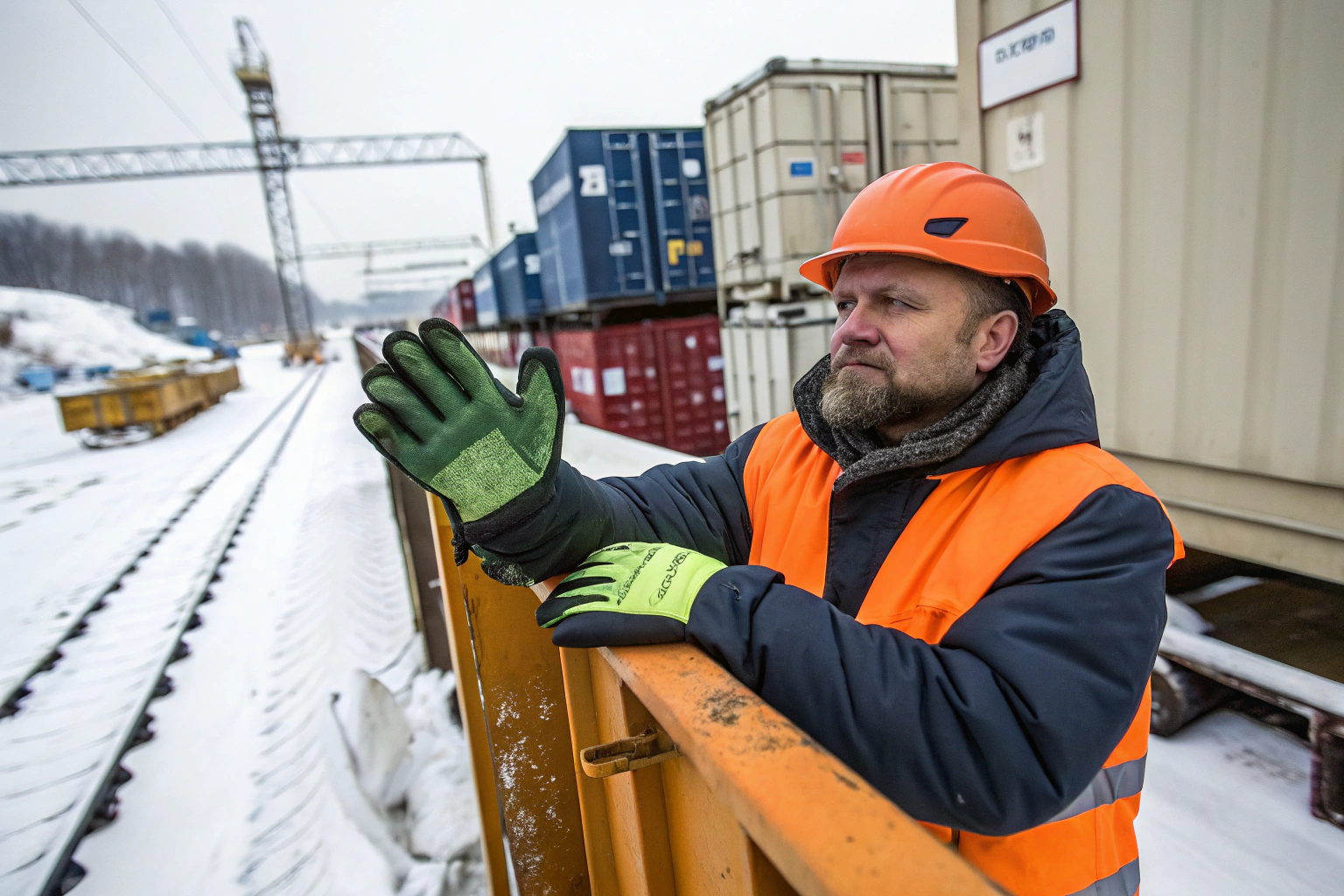
A distributor of industrial safety equipment in Yekaterinburg called me last December with a shipment crisis. He had imported 8,000 pairs of heavy-duty rubber gloves from a new supplier in Malaysia. The gloves had passed all the standard quality checks. The abrasion resistance was excellent. The puncture resistance met the EN 388 standard. The gloves felt thick and substantial in the hand. He shipped them to a mining operation near Norilsk, where winter temperatures regularly drop to minus 45 degrees Celsius. Within the first week, the mine’s safety officer issued a stop-use order. The rubber had become so stiff in the cold that workers could not bend their fingers. When they forced the gloves to grip a handrail, the rubber cracked across the knuckles. The entire shipment was condemned. The distributor had never specified cold-flex testing in his purchase order. The factory had never mentioned it. He lost the contract, and the mining company blacklisted him from future tenders. He called me asking what had gone wrong and how he could prevent it from ever happening again.
Russian buyers require cold-flex testing for rubber gloves because the country’s industrial regions experience some of the most extreme winter conditions on the planet, and a rubber compound that is flexible at room temperature can become dangerously brittle at minus 30 or minus 40 degrees Celsius. Cold-flex testing, performed according to ASTM D2137 or the equivalent GOST standard, measures the lowest temperature at which a rubber material can be bent through a specified angle without cracking. A sample of the glove material is conditioned at progressively lower temperatures in a controlled bath, then subjected to a standardized bending force. The cold-flex temperature, also called the brittleness temperature, is the point at which the rubber fractures. For gloves used in European Russia, a cold-flex rating of minus 30 degrees Celsius is the typical minimum. For Siberian and Arctic operations, minus 40 or minus 50 degrees Celsius is required. This test is not optional. It is a mandatory safety requirement enforced by Russian industrial safety regulations and by the EAC certification system for personal protective equipment. A glove without cold-flex certification is not legally permitted for use in cold-environment industrial applications in the Russian Federation.
The Russian market for protective gloves is unlike any other. The cold is not an occasional inconvenience. It is a constant, life-threatening presence for millions of workers. The oil fields of Western Siberia, the gas pipelines of Yamal, the diamond mines of Yakutia, these are places where human labor and extreme cold coexist by necessity. The glove on a worker’s hand is the barrier between flesh and frostbite. At AceAccessory, we produce rubber and synthetic gloves for cold-climate markets worldwide. We learned early on that the Russian buyer’s insistence on cold-flex testing is not bureaucratic rigidity. It is hard-won wisdom from decades of operating in the world’s most demanding winter conditions. Let me explain the science, the standards, and the practical realities behind this requirement.
What Is the Cold-Flex Testing Standard for Rubber Gloves
Cold-flex testing is a standardized method for determining the temperature at which a rubber material transitions from flexible to brittle. It is not a single universal test. Different industries use slightly different standards, but the underlying principle is the same. A rubber specimen is cooled to a specific temperature, held there until the entire sample reaches equilibrium, and then subjected to a sudden bending or impact force. The test is repeated at progressively lower temperatures until the rubber cracks or shatters. The lowest temperature at which the rubber survives without damage is the cold-flex temperature.
The primary cold-flex testing standards used for rubber gloves are ASTM D2137, ISO 812, and GOST 408. ASTM D2137 is the American standard, widely recognized in international trade. It uses a motorized bending arm to flex a conditioned rubber strip through a 90-degree angle. The test fluid is typically methanol or ethanol cooled with dry ice or liquid nitrogen. ISO 812 is the international standard, similar in principle but with specific differences in specimen dimensions and test speed. GOST 408 is the Russian national standard, and it is the one most often cited in Russian procurement specifications. The test specimens are cut from the finished glove, not from a raw material sheet, because the vulcanization and molding process can change the rubber’s low-temperature properties. The specimens are usually rectangular strips measuring 40 millimeters long by 6 millimeters wide by 2 millimeters thick. They are clamped at one end and immersed in the temperature-controlled bath. After a conditioning period, typically 3 to 5 minutes, the bending arm pushes the free end of the specimen. A pass means no visible crack appears. The temperature is then lowered by 5 degrees Celsius, and a new specimen is tested. The brittleness temperature is the lowest temperature at which all specimens pass.
The test is deceptively simple but requires precise temperature control. A temperature error of just 2 or 3 degrees can change the result. The cooling fluid must be compatible with the rubber. Some rubbers swell or degrade in alcohol baths, which can affect the test outcome. The test speed matters. A faster bend is more severe and will produce a higher brittleness temperature than a slower bend. The test operator must be trained, and the equipment must be calibrated regularly. Let me explain the two most important testing details.
How Does the ASTM D2137 Test Method Work for Glove Materials?
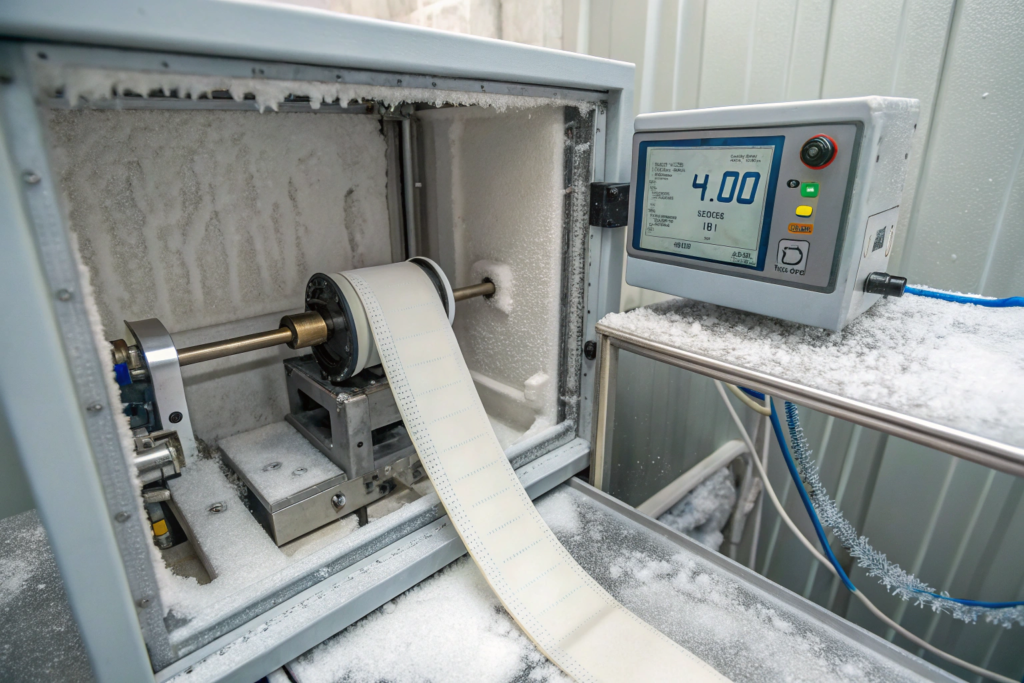
ASTM D2137 is titled "Standard Test Methods for Rubber Property—Brittleness Point of Flexible Polymers and Coated Fabrics." It is one of the most commonly specified test methods in international trade for cold-climate rubber products. The test apparatus consists of a specimen clamp, a temperature-controlled bath, and a motorized bending mechanism. The clamp holds five specimens at a time, each in its own slot. The clamp is lowered into the bath fluid, which has been pre-cooled to the starting test temperature. The specimens soak for 3 minutes. The bending mechanism then sweeps through the clamp at a controlled speed, striking the free ends of the specimens and bending them through approximately 90 degrees. The specimens are removed from the bath and inspected immediately under good lighting. A crack is defined as any visible separation of the rubber surface. A hairline fissure counts as a failure. If all five specimens pass, the test is repeated at a temperature 5 degrees Celsius lower with fresh specimens. The brittleness temperature is recorded as the lowest temperature at which no specimen cracks. For a pass-fail certification at a specific temperature, such as minus 30 degrees Celsius, the test is run at that single temperature. The report states "No failure at minus 30 degrees Celsius." The ASTM D2137 test is valued by rubber technologists because the bending motion approximates the flexing of a glove finger. The clamped end represents the base of the finger. The free end represents the fingertip. When a worker bends their fingers to grip a tool, the rubber on the outer curve of the knuckle is stretched in much the same way.
What Is the Difference Between Brittleness Temperature and Glass Transition?
These two terms are often confused, but they describe different physical phenomena. The glass transition temperature, abbreviated as Tg, is a fundamental material property. It is the temperature at which the amorphous regions of a polymer transition from a hard, glassy state to a soft, rubbery state. At temperatures below Tg, the polymer chains are frozen in place. The material is stiff and brittle. At temperatures above Tg, the chains have enough thermal energy to move and flex. The material is soft and elastic. The Tg is measured by sophisticated laboratory instruments like Differential Scanning Calorimetry or Dynamic Mechanical Analysis. It is a precise scientific measurement. The brittleness temperature, measured by ASTM D2137 or similar tests, is an empirical, practical measurement. It is the temperature at which a specimen of a specific thickness and shape, subjected to a specific bending force at a specific speed, cracks. The brittleness temperature is influenced by the Tg, but it is not the same as the Tg. Additives like plasticizers can lower the brittleness temperature significantly without changing the Tg by the same amount. The specimen thickness affects the result. A thicker specimen will crack at a higher temperature than a thinner specimen of the same material. The test speed affects the result. Rubber is viscoelastic. It behaves differently at different rates of deformation. A fast bend is more likely to cause cracking than a slow bend. For practical purposes, the brittleness temperature is the more useful number for a glove buyer. It answers the question, "At what temperature will this glove crack when I bend my fingers?" The Tg answers the question, "At what temperature does this polymer fundamentally change its state?" Both are valuable, but the brittleness temperature is the one that appears on procurement specifications.
Why Do Russian Winters Demand Special Rubber Formulations
Russia’s geography and climate create a set of working conditions that are unmatched in their severity. The country’s industrial heartland lies in regions that experience prolonged, deep cold. This is not a matter of a few cold days per year. It is months of continuous sub-zero temperatures. The rubber gloves worn by workers in these regions must function not just on an average winter day, but on the coldest days, when the temperature plunges to its extreme lows. Standard industrial rubber gloves, formulated for the moderate climates of Western Europe or North America, simply cannot perform in these conditions. The Russian buyer knows this from experience. They have seen standard gloves fail. They have dealt with the injuries, the lost productivity, and the wasted procurement budgets. This is why they demand proof, in the form of cold-flex test reports, that the rubber has been specifically formulated for their environment.
Russian winters demand special rubber formulations because conventional rubber compounds stiffen and crack at the temperatures routinely encountered in Russian industrial regions. The key climatic factors are the absolute low temperatures, which reach minus 40 degrees Celsius in Western Siberia and minus 50 or below in Yakutia and the Arctic. The duration of the cold, where temperatures remain below minus 20 degrees Celsius for three to five months of the year, meaning the gloves are in continuous cold service. The temperature fluctuations, where gloves may be worn in a heated vehicle or control room, then immediately exposed to extreme cold, subjecting the rubber to thermal shock. And the combination of cold with other stressors, such as oil, grease, mechanical abrasion, and moisture, which can accelerate the degradation of low-temperature properties. Standard nitrile rubber, widely used for industrial gloves because of its oil resistance, typically has a brittleness temperature around minus 20 to minus 25 degrees Celsius. This is adequate for a winter in Germany or the northern United States. It is completely inadequate for a winter in Novosibirsk or Surgut. Arctic-grade rubber compounds use specialized polymer blends and plasticizer systems to push the brittleness temperature down to minus 40 or minus 50 degrees Celsius. The cost of these compounds is higher, and the processing is more demanding, but they are the only materials that will function reliably in the target environment.
The rubber formulation is not a generic recipe. It is a specific combination of polymer type, plasticizer, filler, curing system, and antioxidant. Each component affects the low-temperature performance. Changing one component requires re-testing to confirm the cold-flex rating. Let me explain the two most important material considerations.

How Does Rubber Composition Affect Cold-Flex Performance?
The polymer is the backbone of the rubber compound, and different polymers have inherently different low-temperature capabilities. Natural rubber, polyisoprene, has good low-temperature flexibility in its pure form, with a Tg around minus 70 degrees Celsius. It can be formulated to remain flexible at very low temperatures. Its limitation for industrial gloves is its poor oil and chemical resistance. It swells and degrades when exposed to petroleum products, making it unsuitable for oil field and mining applications. Nitrile rubber, a copolymer of butadiene and acrylonitrile, is the workhorse of the industrial glove industry because of its excellent oil resistance. Standard nitrile has an acrylonitrile content of 30 to 35 percent, which gives good oil resistance but relatively poor low-temperature flexibility. The Tg of standard nitrile is around minus 25 to minus 30 degrees Celsius. Low-temperature nitrile, also called Arctic nitrile, uses a lower acrylonitrile content, typically 18 to 25 percent. The lower acrylonitrile reduces oil resistance slightly but dramatically improves low-temperature flexibility. Arctic nitrile can achieve a brittleness temperature of minus 40 to minus 50 degrees Celsius. The trade-off between oil resistance and cold flexibility is a fundamental design decision. The buyer must specify which property is more critical for their application. Chloroprene rubber, Neoprene, has a Tg around minus 40 degrees Celsius and good oil resistance. It is a popular choice for cold-climate gloves where both properties are needed. The plasticizer system is equally important. Plasticizers are oils that are added to the rubber compound to increase flexibility. Standard plasticizers can crystallize or become viscous at low temperatures, actually making the rubber stiffer. Arctic-grade plasticizers, such as specific sebacates and adipates, remain fluid at very low temperatures and maintain the rubber’s flexibility.
What Plasticizers Prevent Rubber From Cracking in Extreme Cold?
Plasticizers are the unsung heroes of cold-flex rubber performance. A rubber compound without plasticizer is like a sponge without water. It is stiff, hard, and unyielding. The plasticizer molecules insert themselves between the polymer chains, pushing them apart and allowing them to slide past each other more easily. This increases the softness and flexibility of the rubber. For cold-climate performance, the plasticizer must do more than just soften the rubber at room temperature. It must remain effective at the lowest use temperature. Standard plasticizers used in rubber compounding include mineral oils, paraffinic and naphthenic oils, and phthalate esters like DOP, dioctyl phthalate. Mineral oils are economical but have poor low-temperature properties. They become viscous and waxy in the cold. Phthalate esters are better, with lower pour points, but they can crystallize at very low temperatures. Arctic-grade plasticizers are specialty chemicals designed for extreme cold. Sebacate esters, such as DOS, dioctyl sebacate, and DBS, dibutyl sebacate, have exceptionally low pour points, below minus 60 degrees Celsius. They remain fluid and effective at the lowest temperatures encountered in Siberia. Adipate esters, such as DOA, dioctyl adipate, are similar. Polymeric plasticizers are high-molecular-weight molecules that are less prone to migration and extraction. They provide long-term cold-flex stability. The plasticizer must be compatible with the polymer. An incompatible plasticizer will bleed out of the rubber over time, leaving it stiff and shrunken. The plasticizer must also be resistant to extraction by oils and chemicals. A plasticizer that dissolves in crude oil or hydraulic fluid will be leached out of the glove during use, causing it to stiffen. The Arctic-grade rubber compound is a carefully balanced formulation. The polymer provides the mechanical strength and chemical resistance. The plasticizer provides the low-temperature flexibility. The filler, usually carbon black or silica, reinforces the rubber. The curing system cross-links the polymer chains. Every ingredient affects the cold-flex performance, and the formulation must be developed and tested as a complete system.
How Is Cold-Flex Compliance Verified for the Russian Market
A cold-flex test report from the factory’s own laboratory is not enough for the Russian market. The buyer needs independent, third-party verification from an accredited laboratory. This is a legal requirement under the EAC certification system for personal protective equipment. The laboratory must be accredited to ISO 17025, the international standard for testing laboratory competence. The accreditation must cover the specific test method, ASTM D2137, ISO 812, or GOST 408. The test report must be current, typically within the last one to two years. An outdated report does not prove that the current production batch uses the same rubber formulation. The test report is part of a larger compliance package that the Russian importer uses to obtain the EAC certificate of conformity, which is the legal authorization to sell the gloves in the Russian Federation.
Cold-flex compliance for the Russian market is verified through a three-step process. Step one, the factory submits glove samples to an ISO 17025 accredited laboratory. The laboratory performs the cold-flex test according to the specified standard and issues a formal test report. The report must include the laboratory’s accreditation details, the test method, the test temperatures, the results for each specimen, and the final brittleness temperature. Step two, the Russian importer includes the test report in their application for EAC certification. The certification body, a notified body accredited by RusAccreditation, reviews the test report along with other required documents, including the technical description of the glove, the manufacturer’s quality management system certification, and samples of the product labeling. If everything meets the requirements, the certification body issues a certificate of conformity. Step three, the glove is labeled with the EAC mark and with its declared protective properties, including the cold-flex rating in Russian language. The label might read "Морозостойкость: -40°C," meaning "Frost resistance: minus 40 degrees Celsius." This label is the consumer-facing proof of certification. The glove can now be legally imported and sold in the Russian market. Customs will check the EAC mark and the accompanying documentation. Retailers and industrial procurement departments will verify the certification before purchasing.
The verification process is rigorous because the consequences of glove failure in extreme cold are severe. A worker with cracked gloves in minus 40 degrees can suffer frostbite in minutes. The Russian regulatory system places the burden of proof on the manufacturer and the importer to demonstrate that their product is safe. Let me explain the two key verification elements.
What Role Does the EAC Certificate Play in Glove Imports?
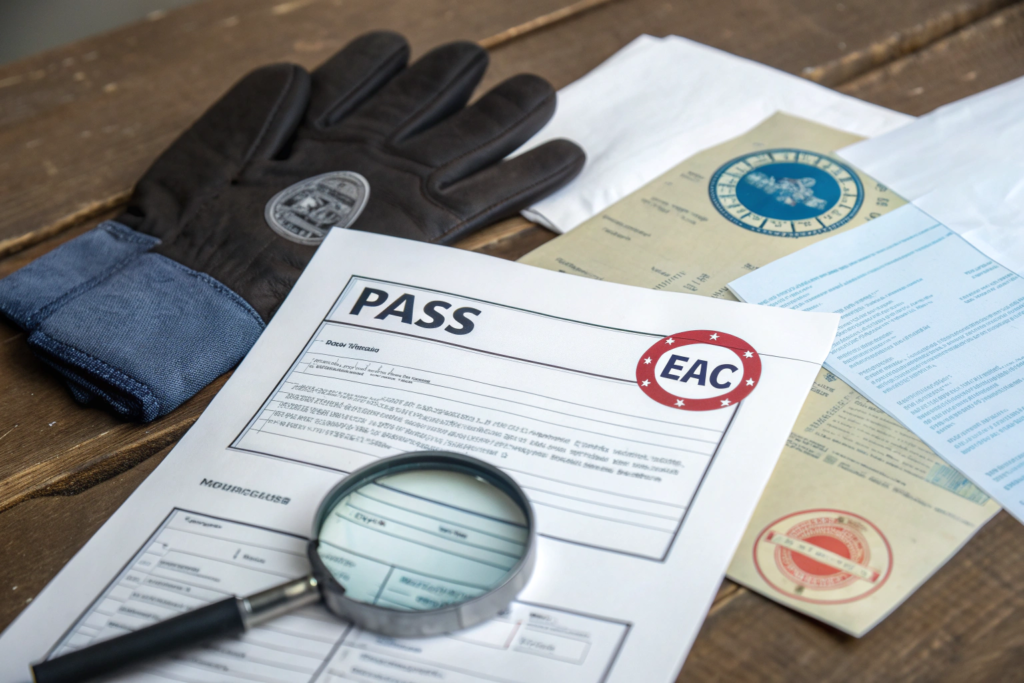
The EAC certificate, the Eurasian Conformity certificate, is the mandatory document that authorizes personal protective equipment to be sold in the Eurasian Economic Union. For rubber gloves intended for cold-environment use, the certificate confirms that the gloves meet the requirements of TR CU 019/2011, the Technical Regulation on the Safety of Personal Protective Equipment. This regulation classifies protective gloves by the hazards they protect against. Cold-resistant gloves are classified as protecting against low temperatures. The regulation requires that the gloves be tested to verify their declared protective properties. The cold-flex test is the test method used to verify the declared cold resistance. The EAC certificate is issued by a certification body accredited by the national accreditation authority of one of the EAEU member states. For the Russian market, the certification body is accredited by RusAccreditation. The certificate is valid for a defined period, typically one to five years, and requires periodic surveillance audits. The certificate is specific to a manufacturer and a glove model. A new glove model, or a change in the rubber formulation, requires a new certificate or an amendment to the existing certificate. The importer of record, the Russian company that brings the gloves into the country, is the certificate holder. They are legally responsible for the compliance of the product. This is why Russian importers are so diligent about requiring cold-flex test reports. They are the ones who will face legal consequences if the gloves are found to be non-compliant. The factory’s role is to provide the importer with all the technical documentation needed to obtain and maintain the EAC certificate.
Can a Factory’s In-House Test Results Be Accepted?
Generally, no. Russian regulatory practice and the requirements of most industrial procurement departments specify third-party testing by an independent, accredited laboratory. A factory’s in-house test results, even if performed on calibrated equipment, are not considered sufficiently independent. The concern is potential conflict of interest. The factory has a financial incentive to produce passing results. An independent laboratory has no such incentive. There are some limited exceptions. If the factory’s in-house laboratory is itself accredited to ISO 17025 for the specific test method, its results may be accepted. Factory accreditation is rare and expensive to maintain. Most factories rely on external accredited laboratories for their compliance testing. The buyer should always verify the independence of the laboratory. The test report should clearly state the laboratory’s name, address, and accreditation number. The buyer can check the accreditation status online. A factory that claims their in-house results are equivalent to third-party certification should be treated with caution. The Russian buyer’s requirement for independent testing is not negotiable. It is a fundamental part of the procurement process. At AceAccessory, we use independent, ISO 17025 accredited laboratories for all our cold-flex testing. We provide our Russian clients with the complete, unedited test reports. We never ask them to accept our own internal test data as a substitute for third-party certification.
What Happens When Rubber Gloves Fail Cold-Flex in the Field
The cold-flex test is not an academic exercise. It predicts real-world failure. When rubber gloves are used in temperatures below their brittleness temperature, they do not just become uncomfortable. They become unsafe. The failure modes are predictable and have been documented in industrial safety reports for decades. The gloves stiffen. The fingers cannot bend. Grip strength is lost. The rubber cracks at stress points, the knuckles, the webbing between fingers, the wrist. The cracks expose the skin to cold air and to any chemicals or moisture in the environment. The waterproof integrity of the glove is destroyed. What was a protective barrier becomes a conductor of cold and a trap for moisture. The worker is now at risk of cold injury, chemical exposure, and mechanical injury from dropped tools or lost grip.
When rubber gloves fail cold-flex in the field, the consequences cascade through worker safety, operational productivity, and procurement costs. The immediate safety consequence is frostbite. A crack in the glove material creates a direct path for frigid air to reach the skin. At minus 40 degrees Celsius, exposed skin can freeze in as little as 2 to 5 minutes. The worker may not feel the crack occur, especially if their hands are already cold. They only notice when the pain of frostbite begins. The productivity consequence is reduced work capacity. A worker with stiff, cracked gloves cannot perform their tasks efficiently. They must stop work to replace the gloves. If replacement gloves are not immediately available, they must leave the work area. In a remote oil field or mine, this can mean the loss of an entire shift. The economic consequence is increased glove consumption. Gloves that crack must be discarded. A worker might go through multiple pairs per shift. The cost of glove procurement multiplies. A cold-flex-certified glove that lasts a full shift or multiple shifts is far more economical than a cheaper glove that fails in the first hour. The legal and regulatory consequence is liability. If a worker is injured because their protective gloves failed in the cold, the employer is liable. The employer’s safety record is damaged. Insurance costs rise. Regulators may issue fines or stop-work orders. The procurement manager who purchased the non-certified gloves may face disciplinary action.
The field failure of cold-weather gloves is a preventable event. It is prevented by specifying the correct cold-flex rating for the expected service temperature, requiring third-party test reports to verify that rating, and purchasing from reputable manufacturers with documented cold-climate expertise. Let me detail the two most common failure scenarios.
How Quickly Can Frostbite Occur With Cracked Gloves?
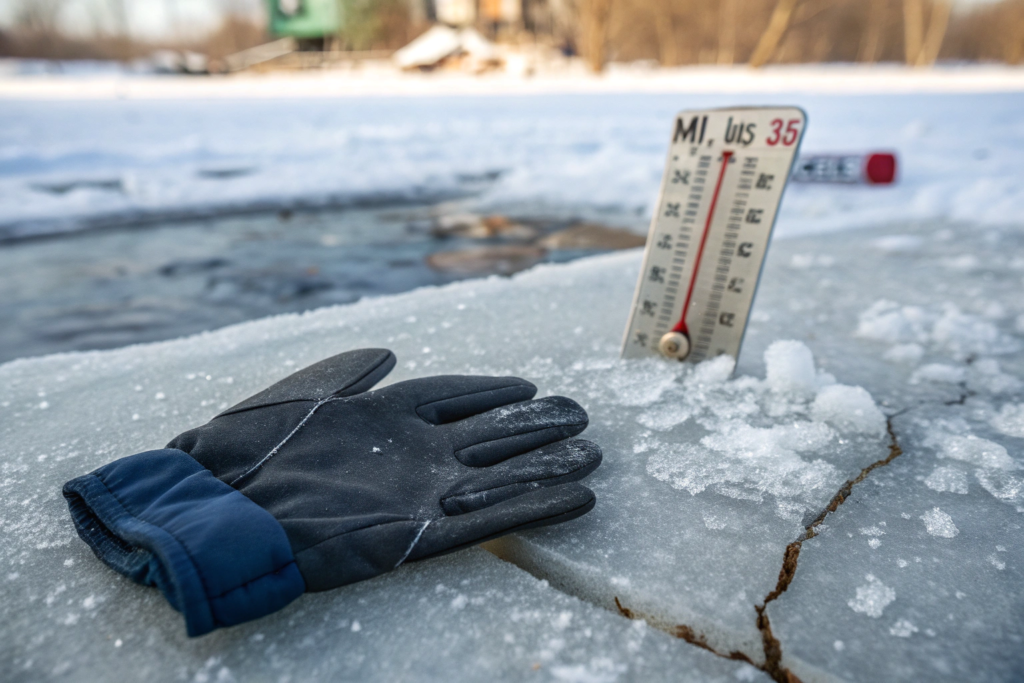
Frostbite is the freezing of skin and underlying tissues. It occurs when skin is exposed to temperatures below the freezing point of tissue, approximately minus 0.5 degrees Celsius. The rate at which frostbite develops depends on the temperature, the wind speed, and the protection, or lack of protection, provided by clothing. The wind chill factor dramatically accelerates heat loss. A temperature of minus 30 degrees Celsius with a 20 kilometer per hour wind produces a wind chill equivalent to minus 45 degrees Celsius. Exposed skin can freeze in 5 to 10 minutes. A cracked rubber glove provides essentially no protection. The crack acts like a small window directly to the skin. Cold air enters through the crack. The microclimate inside the glove, which the body has warmed, is replaced by ambient frigid air. The skin temperature drops rapidly. The first stage of frostbite, called frostnip, is characterized by numbness and a white or pale appearance of the skin. The worker may not notice because the cold itself is an anesthetic. If the exposure continues, ice crystals form within the skin cells. This is superficial frostbite. The skin feels hard and waxy. Blisters may form after rewarming. Deep frostbite involves freezing of the deeper tissues, muscles, tendons, and even bone. The tissue dies. Amputation may be required. The insidious nature of frostbite is that it is painless in its early stages. The worker does not feel a sharp pain when the crack occurs. They simply continue working, unaware that their skin is freezing. By the time they notice the numbness, damage has already occurred. This is why glove integrity in extreme cold is a life-safety issue, not a comfort issue. The cold-flex certification is the assurance that the glove material will remain intact and provide its designed protection at the specified temperature.
What Are the Signs of Cold Degradation in Rubber Gloves?
Cold degradation in rubber gloves is visible and tactile. A trained safety officer or an experienced worker can identify a glove that is failing in the cold before it cracks completely. The first sign is stiffening. The glove feels harder and less flexible than it did at room temperature. The fingers resist bending. The glove may make a rustling or crackling sound when flexed. This stiffening indicates that the rubber is approaching its brittleness temperature. The glove is still intact, but it is no longer providing the dexterity and comfort required for work. The second sign is surface cracking. Fine, hairline cracks appear on the outer surface of the rubber, typically at the flex points. The knuckles are the most common location. The webbing between the fingers is another high-stress area. These cracks are initially small and may be difficult to see. They will grow with continued flexing. The third sign is color change. Some rubber compounds become lighter or develop a cloudy, milky appearance at low temperatures. This is caused by crystallization of the plasticizer or the polymer itself. The color change is an indicator that the rubber’s microstructure is changing and that its mechanical properties are degrading. The fourth sign is permanent deformation. When the glove is removed and allowed to warm to room temperature, it should return to its original shape and flexibility. If it remains stiff or distorted, the rubber has been permanently damaged by the cold exposure. The plasticizer may have crystallized and not fully remelted. The polymer chains may have been broken by the stress of flexing in a brittle state. These signs are the basis for field inspection protocols. Workers are trained to inspect their gloves before each shift, looking for stiffness, cracks, and color changes. Gloves that show any of these signs are discarded. The cold-flex certification ensures that these signs do not appear until the temperature drops below the certified rating.
Conclusion
The Russian buyer’s insistence on cold-flex testing for rubber gloves is a direct, life-safety requirement born from the unique environmental conditions of the Russian industrial landscape. Russia is a country where millions of workers perform essential tasks in winter temperatures that freeze standard rubber solid. The cold-flex test, performed to ASTM D2137 or GOST 408, measures the brittleness temperature of the glove material. It answers the simple question, "At what temperature will this glove crack when I close my hand?" We have explored the testing standards, the precise laboratory methods that cool rubber specimens until they fracture under a controlled bending force. We have examined the material science, the polymer blends and Arctic-grade plasticizers that push the brittleness temperature down to minus 40 and minus 50 degrees Celsius. We have detailed the compliance verification process, the ISO 17025 accredited test reports and the EAC certification that are the legal requirements for the Russian market. And we have described the consequences of field failure, the frostbite, the lost productivity, and the wasted procurement budgets that occur when gloves without cold-flex certification are used in extreme cold.
At AceAccessory, cold-climate performance is a core competency. We formulate our rubber and synthetic glove materials with the specific requirements of Arctic and Siberian service in mind. We source Arctic-grade plasticizers and low-temperature polymers from established chemical suppliers. We test every cold-climate glove model at an independent ISO 17025 accredited laboratory, and we provide the complete test documentation to our Russian and international clients. We understand the EAC certification process and we support our clients with the technical files they need. We do not treat cold-flex testing as an optional add-on. For gloves destined for cold environments, it is as fundamental as the tensile strength or the abrasion resistance.
If you are sourcing rubber gloves for cold-climate markets, for industrial safety in Russia, Scandinavia, Canada, or any region where winter temperatures reach extremes, and you need a manufacturing partner who understands the material requirements, the testing standards, and the compliance documentation, I encourage you to reach out. Contact our Business Director, Elaine, at elaine@fumaoclothing.com. Tell her about your application, your target temperatures, and the standards you need to meet. She can provide samples of our cold-climate materials, share example test reports, and provide a detailed quotation for production. Do not learn about cold-flex failure from a rejected shipment or an injured worker. Build cold-flex compliance into your product specification from the start. Let us help you protect the hands that work in the world’s harshest cold.