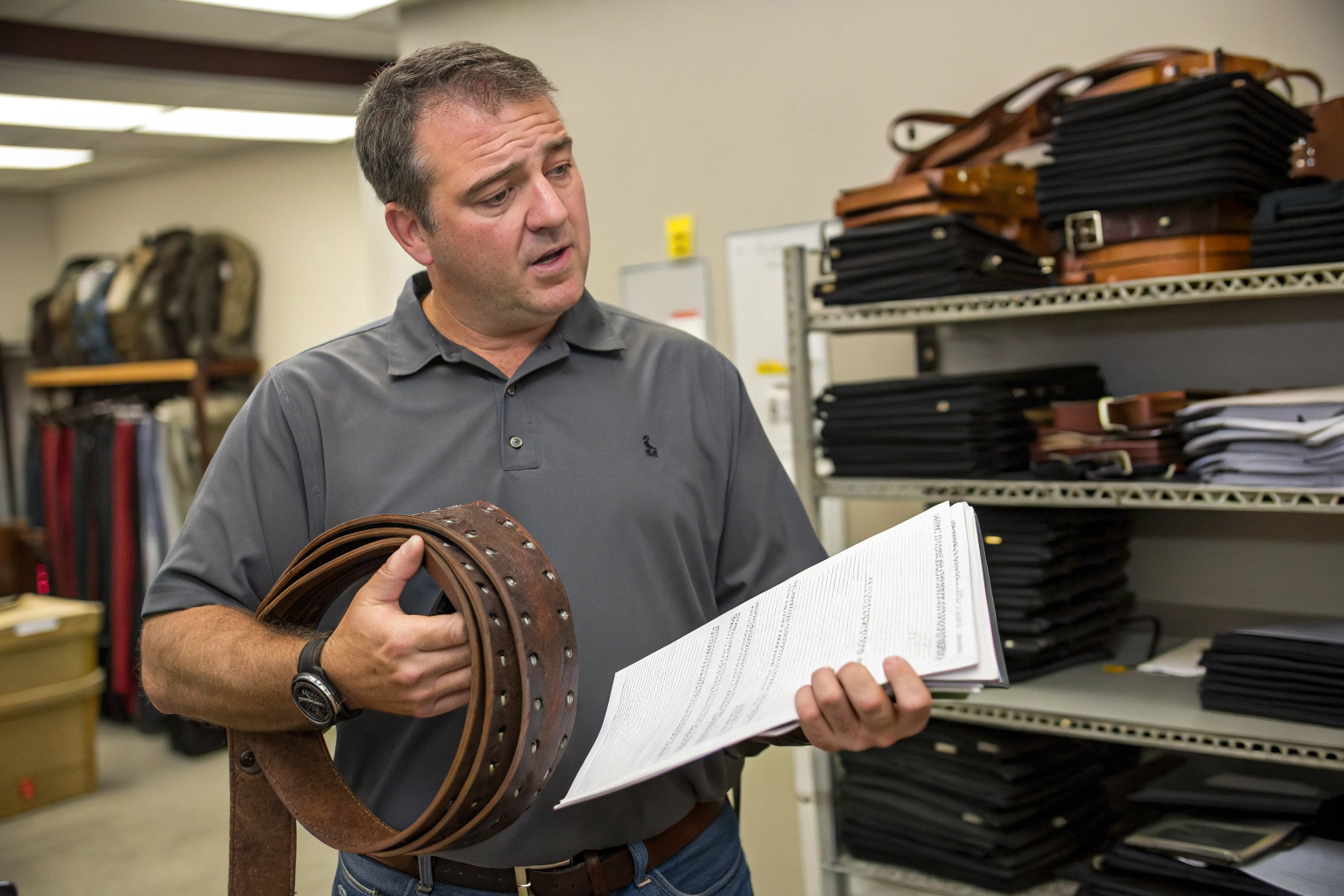
A quality compliance manager from a major American workwear brand called me two years ago with a story that perfectly illustrates why video documentation has become essential. His company had ordered 15,000 heavy-duty leather belts with a specified tensile strength rating. The belts were for construction workers, mechanics, and industrial tradespeople. The factory provided a paper test report showing that the leather had passed the required tensile strength test. The report was stamped, signed, and looked legitimate. But when the belts arrived and were spot-checked by the brand’s quality team, the leather tore at forces far below the specification. The belts were failing in the field. Customers were complaining. Returns were mounting. The brand sent an investigator to the factory and discovered the truth. The factory had tested a single, specially prepared hide that had been selected for its superior thickness and quality. The test report was genuine, but it documented a lie. The belts that shipped were made from lower-grade, thinner leather that could not meet the standard. The brand lost over a hundred thousand dollars and significant customer trust. From that point on, they required continuous, unedited video of every weight and strength test performed on their products.
US importers ask for factory videos of the weight test on belts because video documentation provides verifiable, continuous evidence that the required strength and durability testing was performed on the actual production units, not on specially prepared samples. A weight test on a belt, whether it is a tensile strength test on the leather, a buckle pull test, a snap test, or a load-bearing test on a functional belt like a tool belt or a safety harness belt, measures the belt’s ability to withstand the forces it will encounter in its intended use. For a fashion belt, the test ensures the leather will not tear, the buckle will not break, and the stitches will not rip under normal tension. For a functional belt, the test is a safety issue. A tool belt that fails under load can drop heavy tools onto a worker’s feet. A safety harness belt that fails can result in a fatal fall. A video that captures the entire test process, from the random selection of the belt from the shipping carton to the final force reading on a calibrated machine, provides proof that the test was legitimate. This video evidence protects the importer against product liability claims, satisfies retailer compliance requirements, and deters the most common forms of test fraud in global supply chains.
The weight test on a belt is not a single test. It is a family of tests that evaluate different aspects of the belt’s structural integrity. The leather or webbing tensile strength test measures the force required to break the belt strap itself. The buckle attachment strength test measures how much force is required to pull the buckle off the strap. The stitch strength test measures the force at which the stitching fails. For functional belts, the load test measures the belt’s ability to hold a specified weight without failure. Each of these tests is a critical quality gate. A belt that fails any of them is not fit for purpose. At AceAccessory, we produce belts for fashion brands, workwear brands, outdoor brands, and safety equipment brands. We have invested in calibrated testing equipment, and we provide video documentation of all strength and durability tests as a standard part of our quality control package for US-bound shipments. Let me walk you through exactly what these tests are, why video documentation is required, and what a valid test video must include.
What Weight and Strength Tests Are Performed on Belts
The term "weight test" is a shorthand used by many importers to refer to the suite of mechanical strength tests that a belt must pass. These tests are defined by industry standards, such as ASTM, ISO, and specific retailer protocols. They are designed to simulate the forces a belt experiences during normal use, fastening, tension, load-bearing, and the forces it might experience in a worst-case scenario, a sudden pull or a fall. The tests are destructive. The belt or the component is tested until it fails. The failure point, the maximum force it withstood before breaking, is the test result. This result is compared to a minimum acceptable value. If the failure force is below the minimum, the belt fails the test.
The weight and strength tests performed on belts include the tensile strength test of the strap material. A sample of the leather, webbing, or fabric strap is clamped into a tensile testing machine. The machine pulls the strap apart at a controlled speed, typically 100 millimeters per minute, and measures the force required to break it. The minimum acceptable breaking force depends on the belt type and the material thickness. A standard fashion leather belt strap might be required to withstand 500 to 1,000 newtons. A heavy-duty work belt strap might be required to withstand 2,000 to 4,000 newtons. The buckle attachment strength test measures the force required to pull the buckle off the strap. The buckle is gripped in one clamp, the strap is gripped in the other, and the machine pulls. This tests the strength of the rivets, the screws, or the stitching that attaches the buckle. The minimum acceptable force is typically 500 to 1,000 newtons. The stitch strength test measures the force required to break the stitching that joins the components of the belt, such as the fold-over at the buckle end or the attachment of a keeper loop. The load-bearing test is specific to functional belts. A weight is hung from the belt, which is suspended in a configuration that simulates its intended use. A tool belt might be loaded with 50 to 100 kilograms and must not fail. The test is held for a specified time, typically 10 to 30 minutes, and the belt is inspected for any tearing, seam failure, or hardware deformation. The snap or button pull test, covered in a separate article, is also a strength test, measuring the force to detach a snap or button.
Each of these tests requires a calibrated testing machine, a trained operator, and a documented procedure. The test results are recorded in a test report. The video of the test provides the visual evidence that the test was performed correctly on the correct sample. Let me detail the two most important tests.
How Is a Leather Strap Tensile Strength Test Performed?
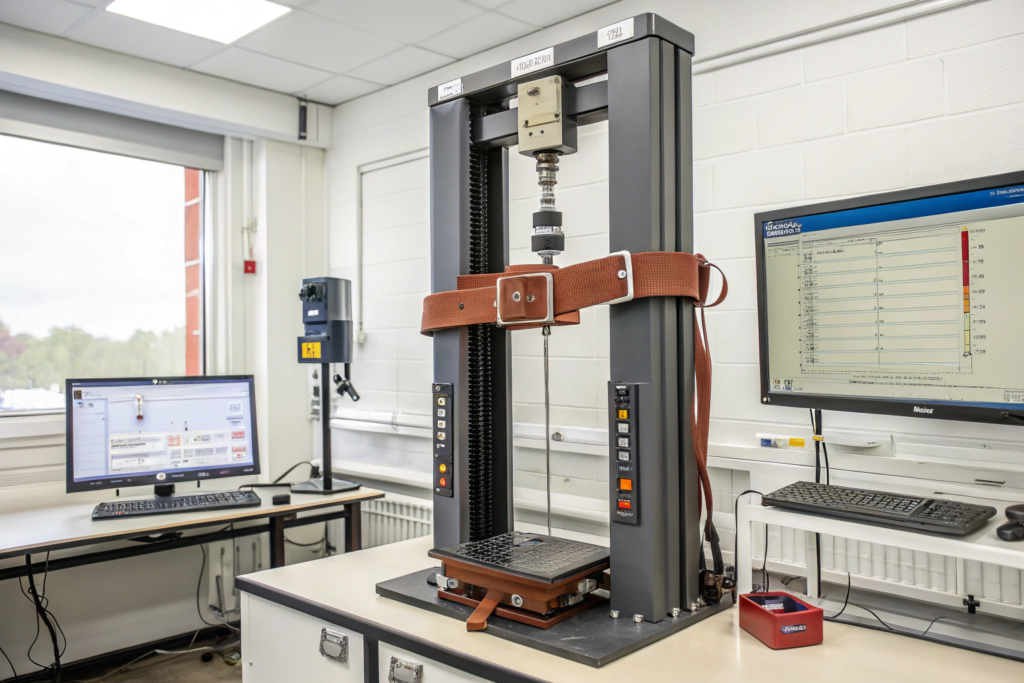
The leather tensile strength test measures the maximum force a leather strap can withstand before it breaks. It is a fundamental material test that verifies the leather quality, the thickness consistency, and the absence of hidden defects like scars, weak spots, or poor tanning that could cause premature failure. The test is performed according to ASTM D2209 or ISO 3376, which are the standard test methods for tensile strength of leather. A sample of the belt strap is cut to a specified shape, typically a dog-bone shape with a defined width at the narrowest point, often 10 millimeters. The shaped sample ensures that the break occurs in the calibrated section, not at the clamp jaws. The sample is conditioned at a standard temperature and humidity, 23 degrees Celsius and 50 percent relative humidity, for at least 24 hours before testing. The sample is clamped into the tensile testing machine. The machine has two jaws, one fixed and one moving. The moving jaw travels upward at a constant speed, typically 100 millimeters per minute, pulling the sample apart. The machine has a load cell that measures the force being applied. The force is recorded continuously and plotted on a graph. The leather stretches, and the force increases. At some point, the leather fibers begin to tear. The force reaches a peak, and then the sample breaks. The peak force is the tensile strength, reported in newtons or in megapascals if divided by the cross-sectional area. A good quality belt leather typically has a tensile strength of 15 to 25 megapascals, which for a strap of standard thickness translates to a breaking force of 500 to 1,500 newtons. The location of the break is noted. A break that occurs at the clamp jaws is invalid because the jaws may have damaged the leather and caused a premature failure. The test must be repeated. The video of the tensile strength test shows the sample being clamped, the machine starting, the leather stretching, and the final break. The force reading on the machine display must be clearly visible throughout.
What Does a Buckle Attachment Pull Test Measure?
The buckle attachment pull test measures the strength of the connection between the buckle and the belt strap. This is often the weakest point on a belt. The buckle is attached by rivets, screws, Chicago screws, or stitching. Each of these attachment methods has a specific failure mode. A rivet can pull through the leather. A screw can strip its threads. A stitch can tear out. The pull test identifies the failure mode and measures the force at which it occurs. The test is performed by clamping the buckle in one jaw of the tensile machine and the strap in the other jaw. The machine pulls the buckle away from the strap, simulating the force applied when the belt is tightened or when it is pulled. The pull is in line with the strap, at 180 degrees, which is the most common and most stressful angle. The force is increased at a controlled rate until the attachment fails. The failure mode is recorded. Did the rivet pull through the leather? Did the leather tear at the fold-over? Did the stitching break? The failure mode provides critical information for improving the design. If rivets are pulling through, the leather may be too thin or too soft, or the rivet washer may be too small. If stitching is breaking, the thread may be too weak, or the stitch density may be too low. The minimum acceptable force for the buckle attachment depends on the belt type. For a fashion belt, 300 to 500 newtons may be acceptable. For a work belt or a tactical belt, 1,000 newtons or more is typically required. The video of the buckle pull test shows the clamping of the buckle and the strap, the initiation of the pull, the progressive application of force, and the moment of failure. The force reading on the machine display is continuously visible. The failure mode is clearly shown in close-up after the test. This video evidence is particularly important because the buckle attachment is a common point of field failure, and proving that the production belts met the standard is a strong defense against liability claims.
How Does Video Documentation Prevent Weight Test Fraud
Test fraud in the global supply chain is a persistent and serious problem. It is driven by the economic pressure on factories to meet price targets and delivery deadlines while minimizing costs. A factory that has cut corners on material quality, that has used thinner leather, cheaper hardware, or less dense stitching than specified, knows that their product will fail a legitimate strength test. To avoid the consequences, they may attempt to falsify the test results. The most common methods of test fraud are sample substitution, machine manipulation, and procedural fraud. Static photographs and paper test reports are vulnerable to all of these methods. A continuous, unedited video is a powerful deterrent and detection tool.
Video documentation prevents weight test fraud by capturing the entire testing process as a continuous, unbroken sequence from sample selection to final result. This continuity makes the most common fraud, sample substitution, extremely difficult. In sample substitution, the factory prepares a golden sample, a belt made with premium materials and extra care, specifically for testing. The test is performed on the golden sample, which passes easily. The test report and photographs are genuine, but they document a different product than the one being shipped. A video that shows the inspector walking to the shipping carton, showing the carton label with the purchase order number, opening the sealed carton, reaching inside to select a random belt, and then immediately testing that same belt, all in one continuous shot, eliminates the opportunity for sample substitution. The second fraud method, machine manipulation, involves tampering with the testing machine to display a false high reading. The calibration can be altered, or the peak hold function can be manipulated. A video that shows the machine being calibrated with a known weight before the test, and then shows the force reading increasing smoothly and continuously during the test, is much harder to fake than a static photograph of a digital display. The third fraud method, procedural fraud, involves performing the test incorrectly, at the wrong speed, at the wrong angle, or stopping the test early, to produce a false passing result. A video that is reviewed by a trained quality professional will reveal procedural errors.
The value of video documentation lies in its continuity and its completeness. A single, unedited video file tells a story that a photograph or a paper report cannot. It is the story of a specific belt, taken from a specific shipment, tested on a specific machine, producing a specific result. Let me detail the two most important aspects of video fraud prevention.
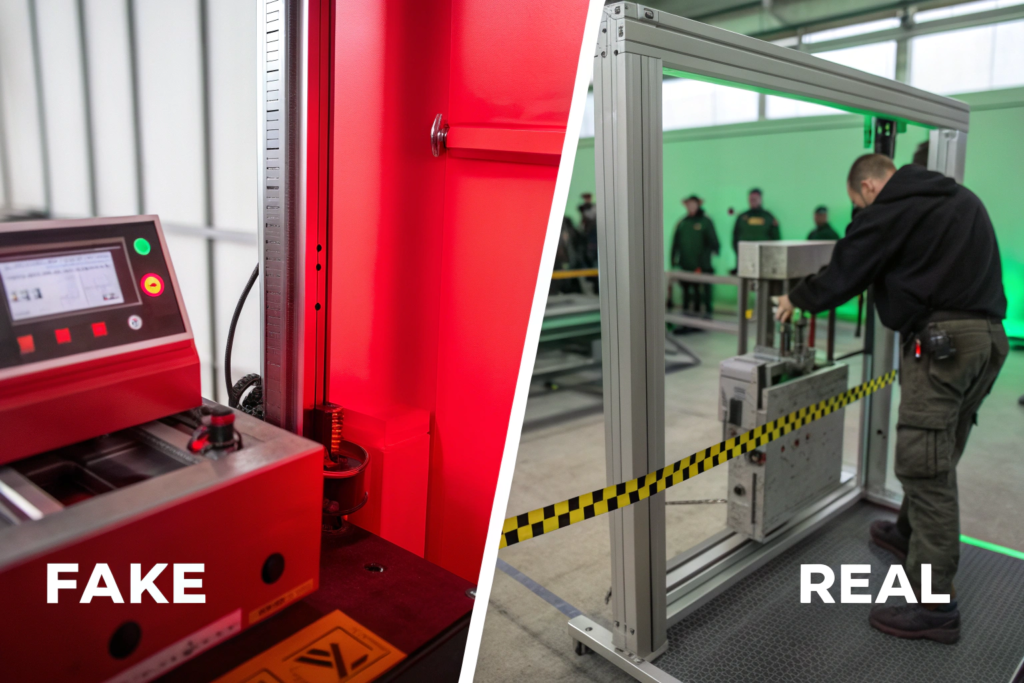
How Do Factories Fake Strength Tests Without Video Evidence?
The most prevalent method of faking a strength test is the golden sample trick. The factory manufactures the production belts using substandard materials. Separately, a small batch of belts is made using the correct, higher-quality materials. These are the golden samples. When it is time to conduct the quality control tests, the golden samples are presented for testing. The test is performed, the results are recorded, and the report is issued. Everything about the test is genuine except the provenance of the sample. The test report states that the tested belt was drawn from production, but it was not. A static photograph of a broken belt and a test machine display cannot prove where that belt came from. A video that shows the entire selection process from a sealed, labeled carton provides that proof. Another method is machine calibration fraud. A digital tensile testing machine can be calibrated to read higher than the actual force. An operator can access the calibration settings and apply a multiplier, so that a force of 500 newtons displays as 1,000 newtons. A belt that breaks at a weak 500 newtons appears on the display to have passed at 1,000 newtons. A photograph of the display captures the false number. A video that includes a calibration check, where a known weight is hung from the machine and the display is shown to read correctly, before the belt test begins, prevents this fraud. The calibration check must be part of the continuous video. Another method is the interrupted test. The operator runs the test, the belt fails at a low force, the operator stops the machine, resets it, and tests a different, stronger belt. Only the second test is photographed and recorded. A continuous video of a single belt being tested, with no cuts or edits, prevents this. The video shows the belt being clamped, the test starting, the force climbing, and either passing or failing. There is no opportunity to swap the belt mid-test.
What Specific Elements Must a Valid Weight Test Video Include?
A weight test video that is acceptable to US importers and retailers must include a specific set of elements, recorded in a specific sequence, without any cuts or edits. Missing any of these elements can render the video invalid. The required elements are designed to establish the provenance of the sample, the validity of the equipment, and the integrity of the test procedure. The elements, in sequence, are as follows. First, the carton identification. The video must begin by showing the shipping carton. The carton label must be clearly visible and legible, showing the purchase order number, the style number, the color, and the quantity. The inspector should read this information aloud. Second, the carton opening. The video must show the sealed carton being opened for the first time. The tape or seal being cut. This establishes that the carton has not been previously opened and tampered with. Third, the random sample selection. The inspector must reach into the middle of the carton, not take a belt from the top, and extract one belt. The belt must remain continuously in the camera frame from the moment of extraction to the completion of the test. Fourth, the equipment calibration verification. The video must show the testing machine’s calibration sticker, with the calibration date and the serial number, in close-up. Ideally, a calibration check with a known weight is performed on camera. Fifth, the test setup. The video must show the belt being clamped into the testing machine. The clamping arrangement must be clearly visible. Sixth, the test execution. The video must show the test being performed from start to finish, with a clear, unobstructed view of the force display throughout. The force reading must be legible. The pull speed must be smooth and consistent. Seventh, the result display. After the test is complete, the peak force reading must be shown in close-up for at least five seconds. The pass or fail determination must be stated audibly or displayed on a written card. Eighth, the date and time verification. The video must be date and time stamped. Ninth, the continuous recording. The video must be a single, unbroken file. Any cut, edit, or jump in the video invalidates it. We follow this protocol exactly for every weight test video we produce.
How Do Weight Test Videos Protect Against US Product Liability
The United States has one of the most stringent product liability legal environments in the world. Under the doctrine of strict liability, a manufacturer, importer, distributor, or retailer can be held liable for injuries caused by a defective product, regardless of whether they were negligent. The injured party does not need to prove that the defendant made a mistake. They only need to prove that the product was defective and that the defect caused the injury. The defenses available to an importer or a retailer include demonstrating that the product was not defective when it left their control, and that they exercised reasonable care in the testing and inspection of the product. The weight test video is a critical piece of evidence for both of these defenses.
Weight test videos protect US importers against product liability by providing objective, verifiable evidence that the belts were tested and met the required strength standards before they were shipped. In a product liability lawsuit, the plaintiff’s attorney will argue that the belt was defective and that the defect caused the injury. The importer’s defense will include the argument that the belt was manufactured and tested to meet all applicable standards. A paper test report is useful but can be challenged as potentially falsified. A continuous video showing the random selection of a belt from the actual shipment, the testing of that belt on a calibrated machine according to a recognized standard, and the achievement of a passing result, is much harder to challenge. It is objective, visual proof. The video also supports the importer’s defense that they exercised reasonable care. It demonstrates that the importer, or the factory on the importer’s behalf, had a robust quality control program that included mechanical testing. This is evidence of responsible corporate behavior. Additionally, for products subject to mandatory safety standards, such as children’s belts under the CPSIA, or for products sold to retailers with stringent vendor compliance programs, the weight test video is often a required piece of the compliance documentation. Failure to provide it can result in refused shipments, chargebacks, and delisting. The video protects not just against legal liability in the courtroom, but against commercial liability in the supply chain.
The legal value of the video is directly proportional to its quality and its adherence to standardized procedures. A video of a poorly performed test on an uncalibrated machine is not just worthless. It is incriminating. It documents the importer’s failure to follow proper procedures. This is why the requirements for what a valid test video must include are so specific. Let me detail the two most important legal applications.

Can a Test Video Defend Against a Failure-to-Warn Claim?
A failure-to-warn claim is a specific type of product liability claim. The plaintiff argues that the product was dangerous in a way that was not obvious to the user, and that the manufacturer or seller failed to provide adequate warnings about the danger. For a belt, a failure-to-warn claim might arise if a belt was marketed as suitable for a particular use, such as a tool belt for heavy construction, but the belt failed under a load that was within the normal range for that use, and the user was injured. The plaintiff might argue that the belt should have carried a warning stating a maximum load limit, and that the absence of such a warning made the belt defective. The weight test video can be a key piece of evidence in defending against this claim. The video demonstrates that the belt was tested to a specific strength standard, and that it passed. If the belt was tested to hold 100 kilograms without failure, the video proves it. The importer can then argue that the belt was adequately strong for its intended use, that the failure must have been caused by misuse, loading beyond any reasonable expectation, or that the specific belt that failed was an isolated anomaly that was not representative of the production batch. The test video supports the argument that the product, as designed and manufactured, was not defective. The video can also support the defense that the warnings provided were adequate. If the belt was sold with a specified weight limit based on the test results, and the video shows the belt passing the test at that limit, the importer has evidence that the warning was based on actual testing, not an arbitrary number. This is evidence of reasonable care in the development of the product’s safety information.
How Does a Test Video Support a Retailer Compliance Audit?
Major US retailers conduct compliance audits of their vendors. These audits review the vendor’s quality control procedures, testing records, and compliance documentation. The retailer’s audit team is responsible for verifying that the products sold in their stores meet the retailer’s safety and quality standards. If a vendor cannot provide adequate documentation, the retailer can impose sanctions, including financial penalties, reduced order volumes, or termination of the vendor relationship. The weight test video is increasingly becoming a required element of the compliance audit for products like belts that have a strength or load-bearing function. The auditor will ask to see the test videos for the production batches that were shipped to the retailer. The auditor will review the videos for the required elements. Carton identification matching the purchase order. Calibration verification. Correct test procedure. Clear force reading. Passing result. If the videos are present and meet the standard, the audit item is passed. If the videos are missing, incomplete, or show improper procedures, the audit item is failed. A failed audit item must be addressed with a corrective action plan, and the vendor is placed on probation. Repeated failures can lead to delisting. The test video is not just a legal defense. It is a commercial necessity for doing business with the most demanding and highest-volume US retailers. We provide our clients with test videos that are organized, labeled, and formatted to meet the specific compliance audit requirements of their retail partners. We understand the audit criteria, and we ensure our documentation satisfies them.
Conclusion
The US importer’s insistence on factory videos of the weight test on belts is a rational, evidence-based response to the realities of global supply chain risk. The weight test is not a formality. It is a fundamental verification that the belt is strong enough for its intended purpose, that the leather will not tear, the buckle will not pull off, and the stitches will not rip under the stresses of normal use. For functional belts used in occupational and safety contexts, the weight test is a safety-critical gate. The video of the test is the evidence that the gate was passed, and that it was passed by the actual products being shipped, not by a golden sample prepared for show. We have explored the types of weight and strength tests performed on belts, from the tensile strength test that measures the leather’s breaking force to the buckle attachment pull test that measures the integrity of the connection. We have examined the methods of test fraud that video prevents, the sample substitution, the machine manipulation, and the procedural shortcuts that have caused product failures and legal liabilities. We have detailed the specific elements that a valid test video must contain, the carton label, the seal breaking, the random selection, the calibration check, the continuous unedited recording. And we have discussed the legal and commercial protection that the video provides, defending against product liability claims and satisfying the compliance audits of major retailers.
At AceAccessory, video documentation of all mechanical strength and safety tests is a standard, non-negotiable part of our quality control process. We have invested in calibrated tensile testing machines, in video recording equipment, and in training our QC team in proper test procedures and video production. We produce weight test videos, buckle pull test videos, stitch strength test videos, and load test videos for every applicable shipment. We organize the video files by purchase order number and provide them to our clients through a secure online portal. We do this because we understand the stakes. A belt that fails in the field is not just a returned product. It is a potential injury, a lawsuit, a damaged reputation, and a lost retail relationship. The test video is a small investment that protects against a catastrophic loss.
If you are sourcing belts for the US market, whether fashion belts, work belts, tactical belts, or children’s belts, and you need a manufacturing partner who provides the documented, verifiable strength testing that US importers and retailers require, I invite you to contact us. Reach out to our Business Director, Elaine, at elaine@fumaoclothing.com. Tell her about your product, your strength requirements, and the documentation your retail partners demand. She can provide sample test videos, walk you through our testing protocols, and provide a quotation for production that includes full mechanical testing and video documentation. Do not rely on a paper report that can be faked. Rely on a video record that proves your belts are as strong as you promise.