I have been in the fashion accessory manufacturing business for over twenty years, and I have watched the humble hair claw clip transform from a basic utility item into a major fashion statement. For a buyer like Ron, who supplies to American retailers and online stores, hair claws and jaw clips are a category with huge potential. They are versatile, affordable, and have been embraced by celebrities, influencers, and everyday consumers. For 2026, the trend is evolving toward bolder, more expressive designs that make a statement.
To source trendy hair claws and jaw clips for 2026, you need to understand the key trends: oversized silhouettes, pearl and crystal embellishments, sculptural metal designs, translucent "jelly" materials, and nostalgic tortoiseshell with modern twists. You also need to consider functionality—the clip must hold hair securely while looking beautiful. Sourcing requires finding a manufacturer who can execute intricate designs with reliable springs and smooth finishes.
At Shanghai Fumao Clothing, we have been producing hair claws and jaw clips for years. We have seen the category evolve and have developed the capabilities to produce the latest trends. We understand that a claw clip is not just a functional item; it is a style statement. I want to share what we have learned so you can build a collection that captures the excitement of this growing market.
What Are The Key Hair Claw Trends For 2026?
Hair claw trends for 2026 are bold, expressive, and diverse. The category has moved far beyond basic black and tortoiseshell. Today’s consumers want clips that reflect their personality and make a statement. Understanding these trends helps you select the right products for your assortment.
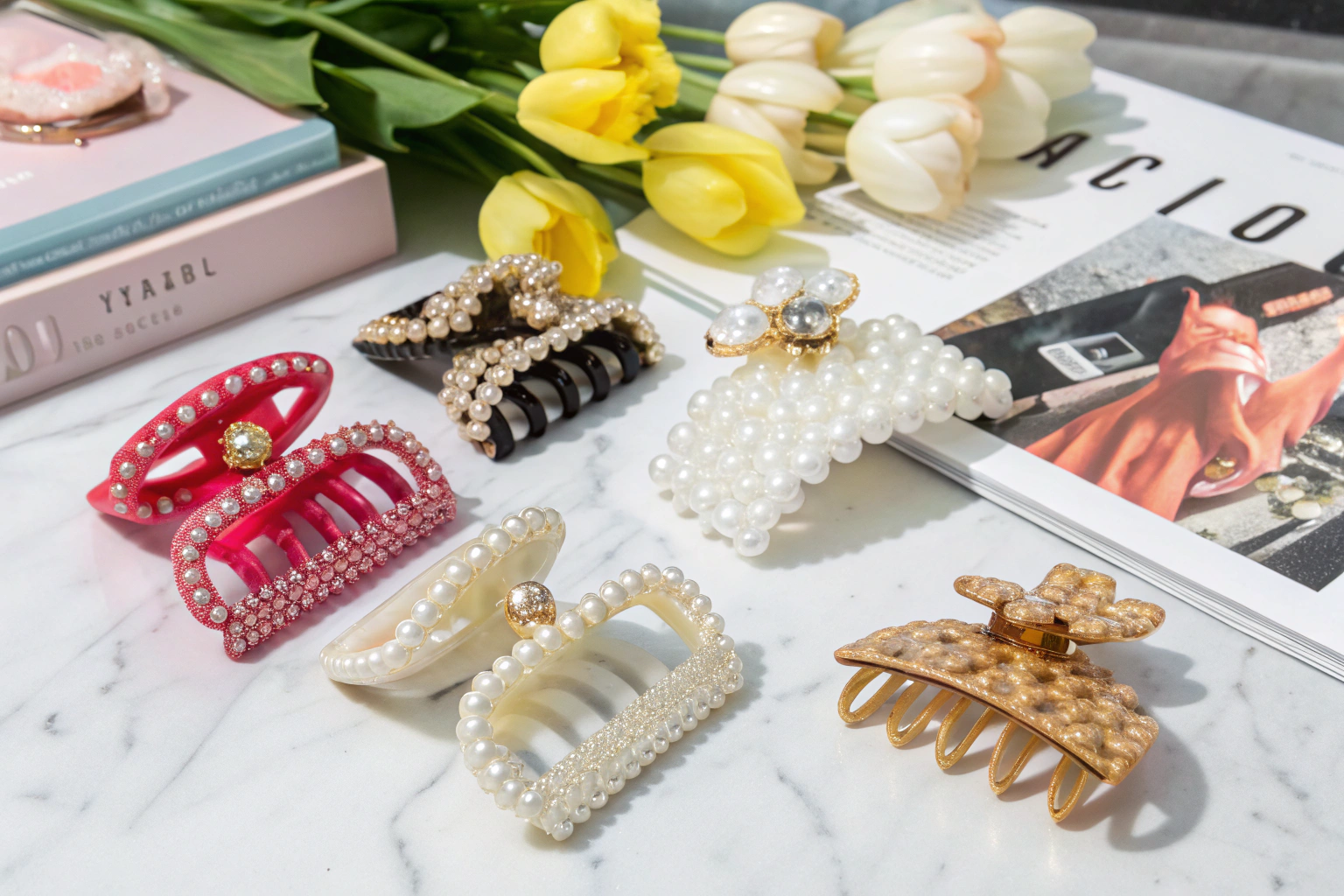
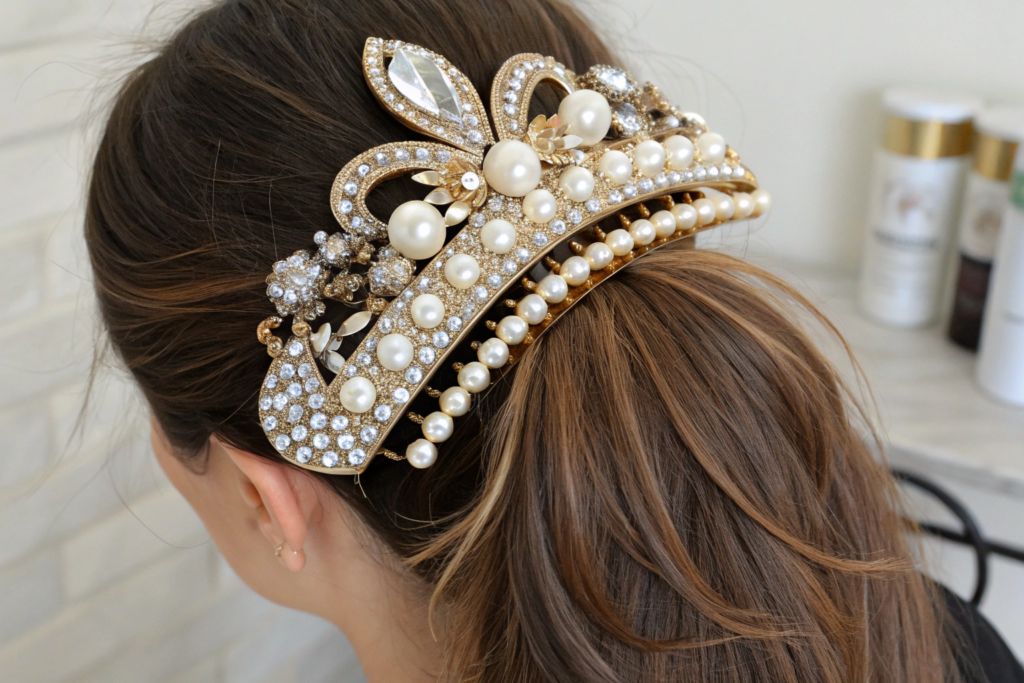
The oversized claw clip is the dominant trend. Larger is better. Clips that can hold thick, long hair are in high demand. These oversized clips are often heavily embellished with pearls, crystals, or metallic details. They are meant to be seen, not hidden. The pearl trend continues strong. Claw clips completely encrusted with faux pearls, often in graduated sizes, create a luxurious, vintage-inspired look. These are popular for both everyday wear and special occasions.
Sculptural metal claw clips are another major trend. These clips are made from metal with geometric, organic, or asymmetrical shapes. They often have a matte or brushed finish. They appeal to consumers who want a modern, architectural look. Translucent "jelly" clips are making a comeback from the 90s. These clips are made from clear or colored translucent plastic. They come in bright neon colors, pastels, and smoky neutrals. They have a playful, nostalgic feel. Tortoiseshell remains a classic, but with modern updates. Today’s tortoiseshell clips come in new color combinations like blue tortoiseshell, pink tortoiseshell, and mixed materials with gold accents.
Why are oversized claw clips dominating the market?
Oversized claw clips have taken over because they combine functionality with fashion. On the practical side, they work for thick, long hair. A small clip simply cannot hold a lot of hair. The oversized clip provides the grip and capacity needed for modern hairstyles. On the fashion side, the oversized clip is a statement piece. It is visible, dramatic, and instantly elevates a look. Celebrities and influencers have been photographed wearing oversized claw clips, driving demand. The trend is also driven by the "effortless chic" aesthetic. An oversized claw clip allows the wearer to pull their hair back quickly while looking stylish. It signals that the wearer is put-together but not trying too hard. For retailers, oversized clips offer higher price points and better margins than smaller clips. They are often embellished, which adds perceived value. At Shanghai Fumao Clothing, we have seen demand for oversized clips surge and have developed a range of sizes and styles to meet this trend.
What are the most popular embellishments for claw clips?
Embellishments are what transform a basic claw clip into a fashion statement. Pearls are the most popular. Full pearl coverage, with pearls of varying sizes, creates a luxurious, textured look. Pearl clusters, where pearls are grouped at the center or one side, offer a more subtle option. Crystals and rhinestones are also highly popular. Crystal-encrusted clips catch the light and feel glamorous. They are popular for evening wear and special occasions. Metal accents, including gold or silver plates, geometric shapes, and sculptural elements, add a modern, architectural feel. Floral embellishments, including resin flowers, fabric flowers, and 3D floral shapes, are popular for spring and summer. Beaded details, using colorful glass or acrylic beads, have a playful, bohemian feel. For 2026, the trend is toward maximalist embellishment. More is more. A single pearl or a small crystal is not enough. Consumers want clips that are fully encrusted, heavily textured, and visually striking. At Shanghai Fumao Clothing, we offer a wide range of embellishment options and can create custom designs to meet your brand’s aesthetic.
How Do I Choose The Right Size And Shape For My Market?
Size and shape are critical factors in hair claw design. The right size ensures the clip is functional for your target customer. The right shape ensures it is comfortable and stylish. Understanding your market helps you select the right options.
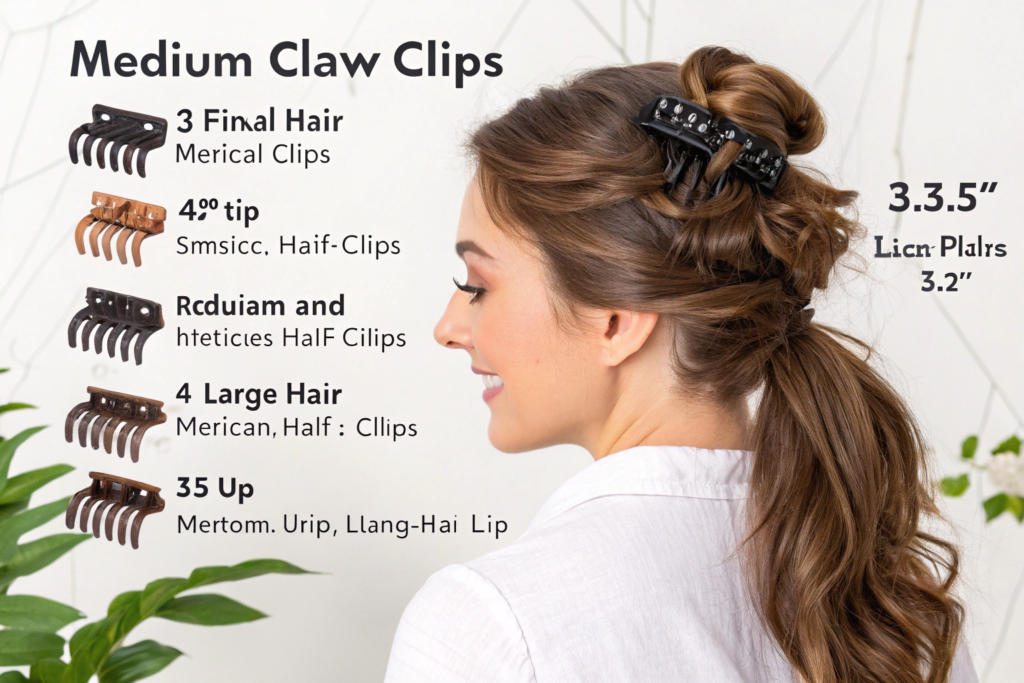
Claw clips come in a range of sizes. Small clips (2 to 3 inches) are designed for fine hair, half-up styles, or as accents. Medium clips (3 to 4 inches) are the most versatile. They work for most hair types and are the standard for everyday wear. Large clips (4 to 5 inches) are for thick, long hair. They hold more hair and make a statement. Extra-large clips (5 inches and up) are the trend-driven option. They are dramatic and eye-catching. For the American market, medium and large clips are the most popular. The average American woman has medium to thick hair. Offering a range of sizes allows you to capture different customers.
Shape also matters. Traditional oval or round claw clips are the most common. They work for most hair types and are comfortable to wear. Rectangular or square clips offer a more modern, geometric look. They are often used in sculptural metal designs. Asymmetrical shapes are trend-driven. These clips have an organic, irregular shape that feels artistic and unique. Curved clips are designed to follow the shape of the head for a comfortable fit. Consider offering a mix of shapes to appeal to different aesthetic preferences.
What size claw clip is most popular for different hair types?
The most popular size depends on the hair type and the desired style. For fine or thin hair, a small clip (2 to 3 inches) is often sufficient. It holds the hair without being too heavy. A medium clip (3 to 4 inches) can also work, but it may be too large for very fine hair. For medium hair, which is the most common hair type, a medium clip is the standard. It holds a full ponytail or a twist securely. A large clip can also work for medium hair if the wearer wants a more dramatic look. For thick or long hair, a large or extra-large clip is essential. A small or medium clip simply cannot hold the volume of hair. It will slip or break. For very thick or curly hair, an extra-large clip with strong spring tension is the best choice. When sourcing, consider offering a range of sizes. A multi-pack with small, medium, and large clips appeals to customers with different hair types. At Shanghai Fumao Clothing, we produce clips in all sizes and can help you determine the right mix for your market based on demographic data.
How do I test that a claw clip fits comfortably and holds securely?
Testing the fit and function of a claw clip is essential before committing to a large order. A clip that does not hold securely or is uncomfortable will lead to returns and negative reviews. Start with a sample. Put the clip in your own hair. Does it open and close smoothly? Does the spring have enough tension? Does it hold the hair securely without slipping? Does it feel comfortable? There should be no pinching or pulling. Next, test on different hair types. Have people with fine hair, medium hair, thick hair, and curly hair try the clip. Does it work for all? For thick hair, the clip should open wide enough to accommodate the hair. For fine hair, the clip should not be so heavy that it pulls. Next, test the durability. Open and close the clip 50 to 100 times. Does the spring weaken? Does the mechanism still work smoothly? Next, test the grip. Put the clip in hair and shake the head vigorously. Does the clip stay in place? Finally, test for comfort. Wear the clip for several hours. Does it cause any discomfort or headaches? A good clip should be virtually unnoticeable when worn properly. At Shanghai Fumao Clothing, we conduct these tests on every new design before offering it to clients.
What Are The Most Popular Materials For 2026 Claw Clips?
The material of a claw clip affects its appearance, durability, and sustainability. For 2026, there is a wide range of materials available, from traditional plastics to innovative sustainable options. Understanding the options helps you select the right material for your brand.
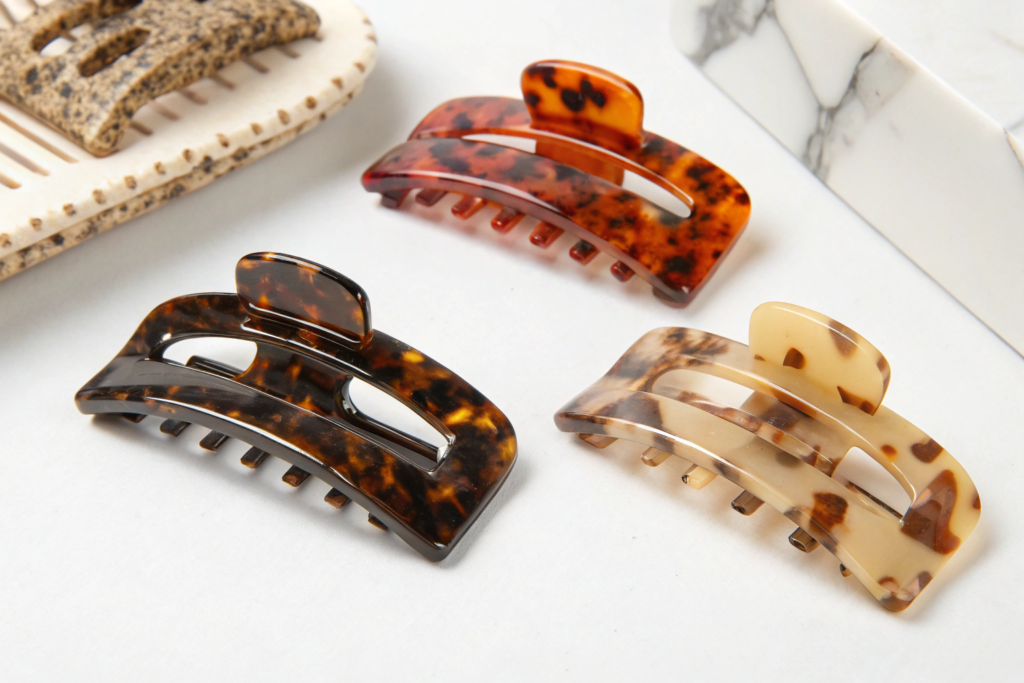
Acetate is a premium material made from wood pulp. It has a natural, warm feel and is available in a wide range of colors and patterns. Tortoiseshell acetate is a classic. Acetate is more expensive than standard plastic but feels more luxurious. It is also more sustainable because it is derived from renewable resources. ABS plastic is the most common material for claw clips. It is durable, affordable, and available in many colors. High-quality ABS has a smooth finish and good flexibility. It is the standard for most mass-market clips.
Recycled plastic (rPET or recycled ABS) is gaining popularity for eco-conscious brands. It offers the same performance as virgin plastic with a lower environmental footprint. Look for GRS certification to verify recycled content. Metal claw clips are a premium option. They are typically made from zinc alloy with a plated finish. Metal clips have a modern, architectural look but are heavier than plastic. They are best for smaller sizes or for customers who do not need to hold a lot of hair. Bioplastics, made from corn or sugarcane, are emerging as sustainable alternatives. They are compostable in industrial facilities. However, they are currently more expensive and less widely available.
How does acetate compare to standard plastic for claw clips?
Acetate is a premium material that offers several advantages over standard plastic. First, it has a natural, warm feel. Unlike plastic, which can feel cold and hard, acetate has a slight warmth and a smooth, polished finish. It is often used in luxury eyewear and accessories. Second, acetate is available in beautiful patterns. Tortoiseshell, marble, and layered patterns are unique to acetate. Standard plastic is typically solid or has a surface print that can wear off. Third, acetate is more sustainable. It is derived from wood pulp, a renewable resource. Standard plastic is made from petroleum, a non-renewable resource. However, acetate has some trade-offs. It is more expensive than standard plastic, typically 30% to 50% higher. It is also less flexible; acetate clips may be more prone to breaking if bent too far. For premium brands or for customers who value sustainability and aesthetics, acetate is an excellent choice. For mass-market or trend-driven items, standard plastic may be more appropriate. At Shanghai Fumao Clothing, we offer both materials and can help you decide based on your brand positioning and price point.
What are the benefits of recycled plastic for eco-conscious brands?
Recycled plastic offers significant benefits for brands that want to reduce their environmental footprint. The most common recycled material for claw clips is rPET (recycled polyethylene terephthalate) or recycled ABS. The material is made from post-consumer waste, such as plastic bottles or electronic waste. Using recycled plastic reduces the amount of waste sent to landfills and oceans. It also uses less energy and water than producing virgin plastic. For your brand, using recycled plastic allows you to make credible sustainability claims. You can market your clips as "made from recycled materials" and appeal to eco-conscious consumers. Certifications like GRS (Global Recycled Standard) provide third-party verification of recycled content. This is important because consumers are increasingly skeptical of vague "green" claims. The performance of recycled plastic is comparable to virgin plastic. It is durable, flexible, and available in a range of colors. The main trade-off is cost. Recycled plastic can be 10% to 20% more expensive than virgin plastic. For many brands, this premium is worth it for the sustainability story. At Shanghai Fumao Clothing, we source GRS-certified recycled plastic and can provide documentation for your marketing.
How Do I Source Quality Claw Clips From China?
Sourcing quality claw clips from China requires finding a manufacturer with the right expertise, quality control systems, and flexibility. Claw clips seem simple, but they have many potential failure points: the spring, the teeth, the hinge, and the finish. A reliable manufacturer understands these details.
Start by looking for a factory that specializes in hair accessories. A factory that makes a wide range of hair clips will have the right molds, materials, and quality control processes. Ask to see their product range. Look for clips with smooth finishes, even teeth, and strong springs. Next, evaluate their quality control. Ask about their inspection process. Do they test springs? Do they check for sharp edges? Do they use AQL sampling? A factory with ISO 9001 certification is a good sign. Next, evaluate their material sourcing. Where do they get their plastic? Do they use virgin or recycled materials? Can they provide material certifications? Next, evaluate their customization capabilities. Can they produce custom colors? Custom molds? Custom packaging? A factory with in-house mold-making capabilities can produce unique designs faster and at lower cost.
Finally, evaluate their communication and reliability. Do they respond promptly? Do they provide clear samples? Do they meet deadlines? A good factory will be transparent about their capabilities and limitations.

What quality control tests should I require for claw clips?
For claw clips, quality control should focus on the spring, the teeth, the finish, and the safety. The spring is the most critical component. The factory should test the spring tension. The clip should open and close smoothly with consistent resistance. The spring should not be too weak (clip will not hold) or too strong (clip is difficult to open). The teeth should be evenly spaced and aligned. Misaligned teeth will snag hair or fail to grip. The teeth should be smooth with no rough edges. The finish should be smooth and even. For plastic clips, there should be no burrs, cracks, or flow lines. For metal clips, the plating should be even with no bubbles or peeling. For embellished clips, test that pearls or crystals are securely attached. Perform a pull test on a sample. For safety, check for sharp edges. Run a finger along the edges, especially around the hinge and spring. For children’s clips, test for small parts. Any embellishment that can detach and fit into a small parts cylinder is a choking hazard. At Shanghai Fumao Clothing, we perform all these tests on every batch of claw clips. We provide inspection reports to our clients.
How do I verify the spring quality before production?
Verifying spring quality before production is essential because the spring is the heart of the claw clip. A weak spring will not hold hair. A stiff spring is difficult to use. A spring that fails after a few uses will lead to returns. Start by asking your factory about their spring supplier. A reputable factory will use springs from established suppliers with consistent quality. Next, request spring samples before production. Test them yourself. Open and close the clip. Does it feel smooth? Is the resistance consistent? Does it open wide enough? Next, test the spring tension. Use a tension gauge if available. The force required to open the clip should be consistent across samples. Next, test the durability. Open and close the clip 100 times. Does the spring weaken? Does the mechanism still work smoothly? Next, test under load. Put the clip in hair or use a test fixture to simulate holding hair. Does the spring hold? Finally, ask the factory for spring test reports. A quality-conscious factory will test springs as part of their incoming material inspection. At Shanghai Fumao Clothing, we test every batch of springs before they go into production. We can provide test reports to our clients.
Conclusion
Sourcing trendy hair claws and jaw clips for 2026 is about capturing the excitement of a category that has become a fashion staple. The key trends are oversized silhouettes, pearl and crystal embellishments, sculptural metal designs, translucent "jelly" materials, and modern tortoiseshell. Choosing the right size and shape for your market ensures functionality and comfort. Selecting the right materials—from premium acetate to sustainable recycled plastic—aligns with your brand values. And customizing with unique colors, embellishments, or custom molds creates a product that stands out.
At Shanghai Fumao Clothing, we have been producing hair claws and jaw clips for years. We have the molds, the materials, and the quality control systems to deliver products that meet the highest standards. We track trends closely and can help you develop a collection that captures the spirit of 2026. Whether you need standard styles or fully custom designs, we have the expertise to bring your vision to life.
If you are ready to source trendy hair claws and jaw clips for your brand, let’s talk. Please contact our Business Director, Elaine, directly at elaine@fumaoclothing.com to discuss your project and how we can help you capture this growing market.