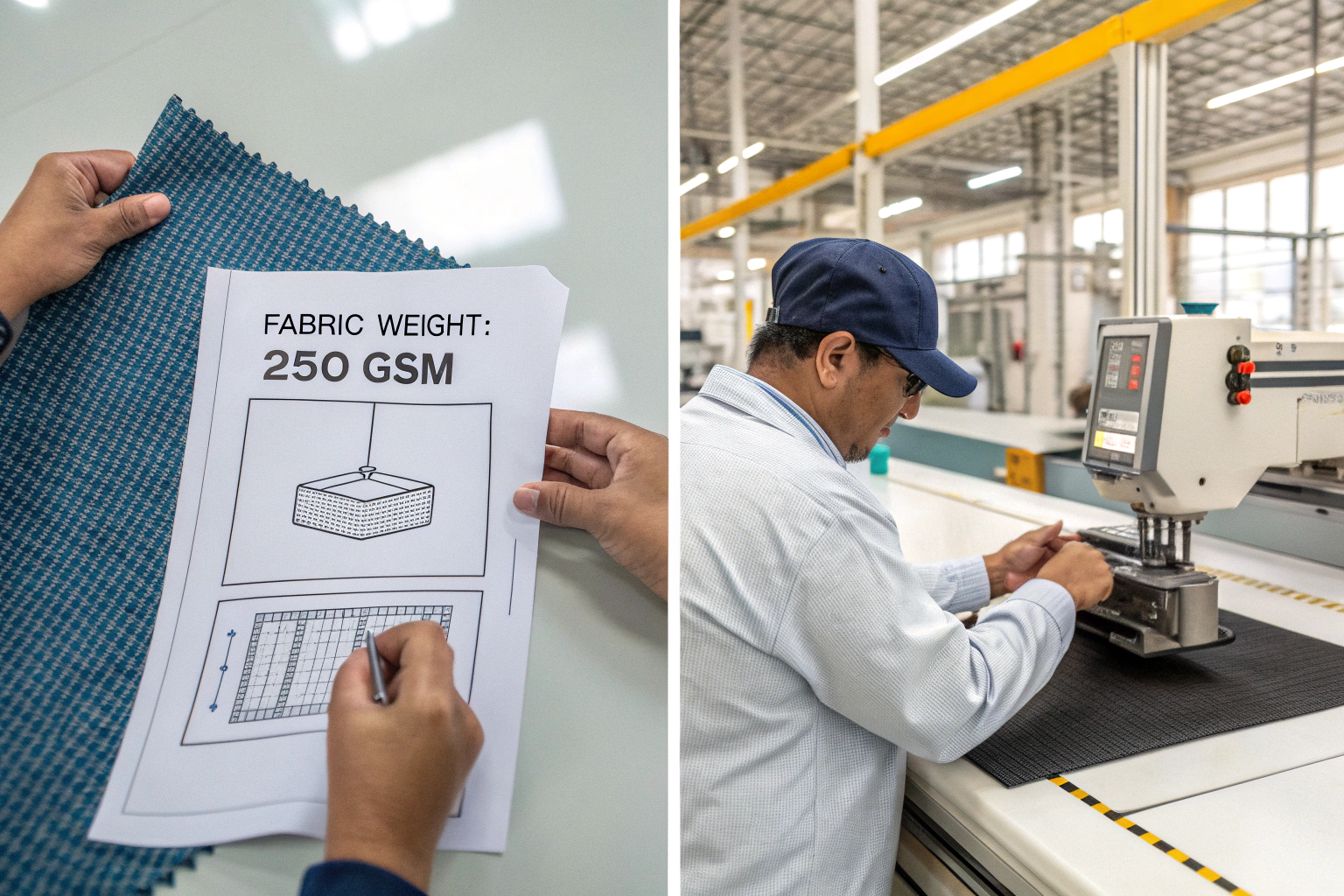
As a brand owner like Ron, you know that the details make the product. You’ve just received a sample of a new knitted scarf for your winter collection. It feels… okay, but is it right? You specified a certain "weight" in your tech pack because you wanted a scarf that felt substantial, cozy, and premium. But how do you know if the factory actually met that specification? You’re worried about approving a sample based on a subjective feeling, only to receive a bulk order of scarves that feel flimsy and cheap, leading to disappointed customers and a damaged brand reputation.
To confirm the weight of a knitted scarf, you must move beyond subjective feel and use objective, standardized industry measurements. The key is to verify the fabric’s "grams per square meter" (GSM), which is the universal standard for fabric weight. This is done by using a precision digital scale and a fabric swatch of a known area, and then comparing this real-world measurement against the GSM value specified in your product’s technical pack.
I’m the owner of Shanghai Fumao Clothing, and this is a conversation I have with brand managers every day. The "hand feel" of a scarf—how heavy, dense, or luxurious it feels—is not magic. It’s a direct result of measurable specifications, with fabric weight (GSM) being the most critical. A factory that can’t have a precise conversation about GSM is not a factory you can trust with your quality. Let’s demystify this crucial quality control process so you can approve your next sample with data-driven confidence.
What Exactly Is "Scarf Weight" and How Is It Measured?
When you say you want a "heavy" or "light" scarf, what does that actually mean in manufacturing terms? You might think it refers to the total weight of the finished product, but that can be misleading. A very large, thin scarf could weigh the same as a small, thick one. You need a standardized unit of measurement to accurately define and verify the fabric’s density.
In the textile industry, fabric weight is standardized as Grams per Square Meter (GSM). This measurement defines the density of the material, independent of the scarf’s final dimensions. A higher GSM means a denser, heavier, and typically warmer fabric. A lower GSM indicates a lighter, more open, and airier fabric. This is the single most important metric for defining the feel of a knitted scarf.
Think of it like paper quality. You know that 120g paper feels thicker and more premium than 80g paper. GSM is the exact same concept for fabrics.
- Lightweight: < 180 GSM. Good for transitional seasons or as a fashion accent.
- Mid-weight: 180-300 GSM. The sweet spot for most standard winter scarves. Cozy and warm without being overly bulky.
- Heavyweight: > 300 GSM. For very chunky, thick, and exceptionally warm scarves, often with a more rugged or oversized look.
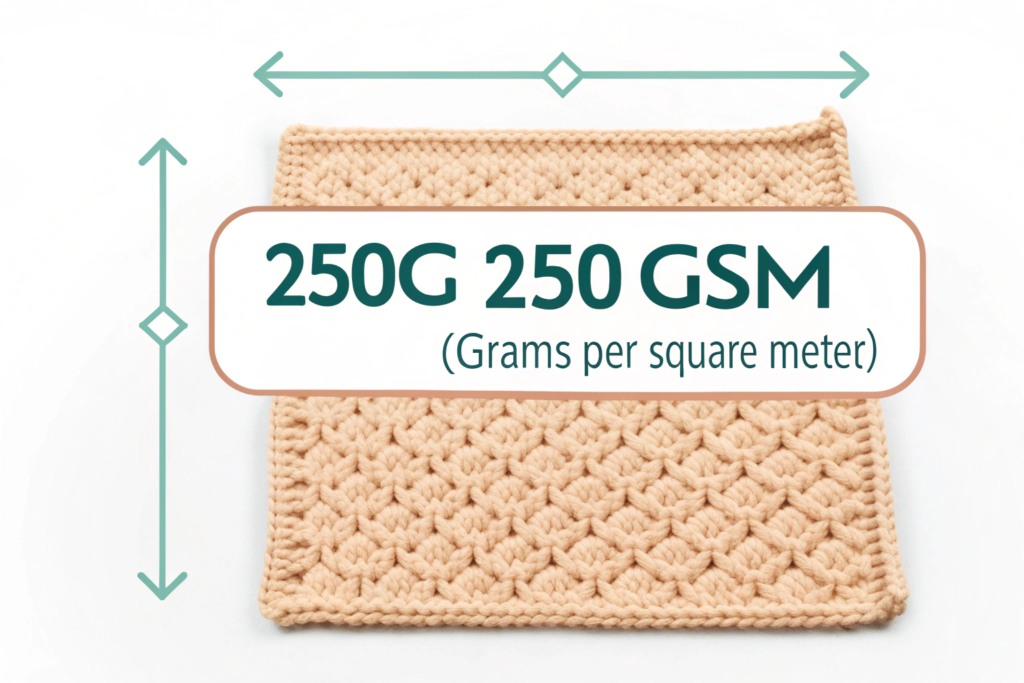
How is GSM different from the total weight?
The total weight of the scarf is simply how much the finished product weighs when you put it on a scale (e.g., 200 grams). GSM is the weight of a specific area of the fabric itself. The total weight will change depending on the scarf’s length and width, but the GSM should remain consistent. For quality control, GSM is the more reliable metric because it measures the fabric’s intrinsic quality.
What factors determine a fabric’s GSM?
The GSM of a knitted fabric is determined by three main factors:
- Yarn Thickness (Yarn Count): A thicker yarn will produce a heavier fabric.
- Stitch Density: How tightly the stitches are knitted together. Tighter stitches result in more yarn being used in a given area, leading to a higher GSM.
- Fiber Type: Different fibers have different natural densities. For example, cotton is generally denser than a comparable acrylic yarn.
How Can I Verify the GSM of a Sample Myself?
You’ve received a scarf sample from your factory. It feels pretty good, but you want to verify the GSM against the 250 GSM you specified in your tech pack. You don’t have a fancy lab. Can you get a reliable measurement yourself with some basic tools?
Yes, you can easily and accurately calculate the GSM of a sample with a few simple tools: a high-precision digital scale (a jewelry or kitchen scale that measures to 0.01g), a sharp cutting tool (like a rotary cutter or fabric scissors), and a ruler. The process involves cutting a precise square of fabric, weighing it, and then performing a simple calculation.
Here is the simple, step-by-step process:
- Get a Precision Scale: You need a scale that can accurately measure small weights. A digital jewelry scale, available online for a low cost, is perfect for this.
- Cut a Precise Swatch: Lay your scarf sample flat. Carefully measure and cut a perfect square of 10cm x 10cm. A rotary cutter and a cutting mat will give you the most accurate cut. A 10cm x 10cm square is 1/100th of a square meter, which makes the math very easy.
- Weigh the Swatch: Place your 10cm x 10cm swatch on the digital scale and record its weight in grams. Let’s say it weighs 2.50 grams.
- Calculate the GSM: Since your swatch is 1/100th of a square meter, you simply multiply its weight by 100 to find the GSM.
- Calculation: 2.50g x 100 = 250 GSM.
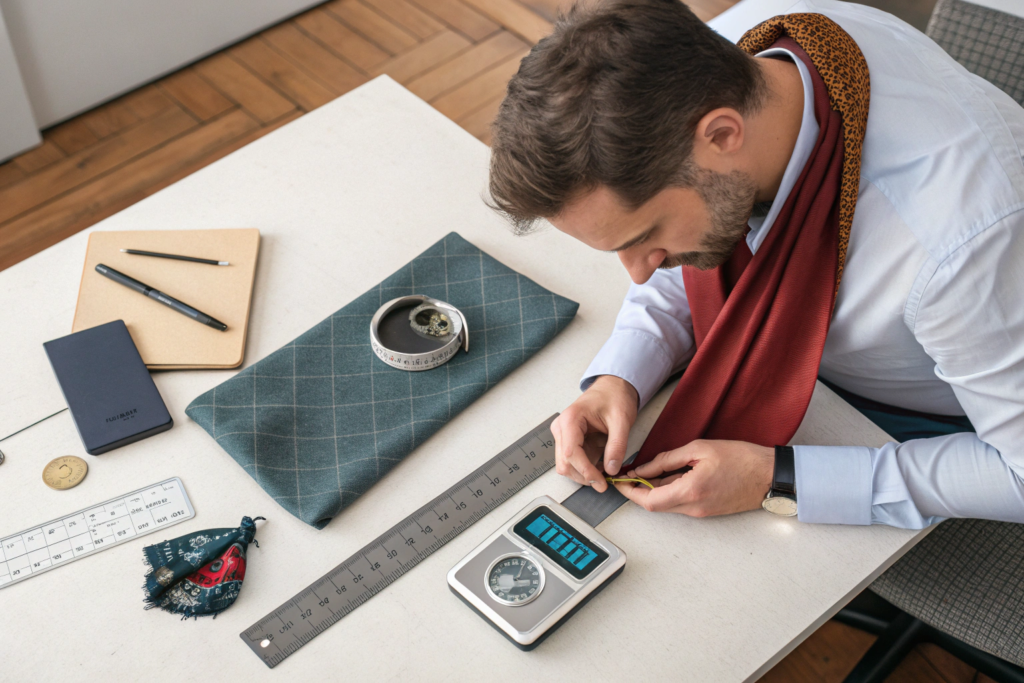
Why is an accurate cut so important?
The calculation relies on the area of your swatch being precise, a detail that can make or break the accuracy of your final GSM (grams per square meter) calculation. Imagine holding a swatch of fabric, its edges slightly frayed or uneven—this inaccuracy will ripple through your numbers, leading to a result that doesn’t reflect the true weight and density of the material. A clean, straight cut is non-negotiable; it’s the foundation upon which all subsequent measurements rest. Using a clear ruler, its smooth surface glinting softly under light, and a sharp rotary cutter, with its keen blade poised to slice through fibers with surgical precision, is highly recommended over the imprecise, often jagged cuts left by scissors.
What if I can’t cut the sample?
If you have a "golden sample" that you cannot cut, you can perform the calculation in reverse. Measure the scarf’s total length and width to calculate its total area in square meters (e.g., 1.8m x 0.3m = 0.54 sq meters). Then, weigh the entire scarf (e.g., 135g). Finally, divide the total weight by the total area (135g / 0.54 sq m = 250 GSM). This method is less accurate due to potential variations in the scarf’s width and stretch, but it can provide a good estimate.
How Do Factories Ensure Consistent Weight in Production?
You’ve confirmed your sample is perfect. Now you’re worried about the bulk production. How does a factory ensure that the 1st scarf and the 5,000th scarf in your order have the same weight and feel? This is where professional quality control and process management come in.
A professional factory ensures consistent weight through rigorous control of the entire production process. This starts with sourcing yarn of a consistent count, precisely calibrating the knitting machines for stitch density and tension, and implementing a systematic Quality Control (QC) protocol where fabric weight is checked at regular intervals throughout the production run.
Consistency is not an accident; it’s a system.
- Yarn Control: The factory must source all yarn for the production run from the same batch to avoid variations in thickness.
- Machine Calibration: Before the run starts, the knitting machines are calibrated to the exact specifications derived from the approved sample. This includes setting the stitch length, needle timing, and yarn tension.
- In-Process QC: A QC technician will periodically take a cutting from the fabric as it comes off the knitting machine and test its GSM. If it starts to deviate, they can pause production and recalibrate the machine. This proactive approach prevents large-scale errors.
This is a key difference between a professional factory and a simple workshop. A professional partner like Shanghai Fumao Clothing has these documented QC systems in place.

What is an acceptable tolerance for GSM?
In the textile industry, a small tolerance is always expected. A standard acceptable tolerance for GSM is typically +/- 5%. So, for a 250 GSM specification, the acceptable range would be from 237.5 GSM to 262.5 GSM. You should agree on this tolerance with your supplier and include it in your tech pack.
How do I enforce this standard?
You can enforce this by specifying that you require a GSM test report from the factory’s internal lab for the bulk production. You can also hire a third-party inspection service (like QIMA or SGS) to go to the factory before the goods are shipped. They will randomly select finished scarves, perform their own GSM tests, and provide you with an independent report confirming that the bulk production meets your specification.
What If the Weight Is Wrong?
You’ve tested your sample, and the GSM is 210, but you specified 250. It feels noticeably lighter than you wanted. What do you do? How do you communicate this to your supplier in a professional and productive way?
If the sample’s weight is incorrect, you must reject the sample and clearly communicate the discrepancy to your supplier using objective data. Do not say "it feels too light." Instead, say "The sample measured at 210 GSM, but our tech pack specifies 250 GSM +/- 5%. Please remake the sample to meet the specification." This data-driven feedback is professional, non-negotiable, and gives the factory a clear target for correction.
This is a critical moment in your relationship with your supplier.
- Be Objective: Stick to the numbers. Your subjective opinion ("it feels flimsy") can be debated, but the measurement (210 GSM) cannot.
- Reference the Tech Pack: Your tech pack is your contract. By pointing to the specific requirement, you are reminding them of the agreed-upon standard.
- Ask for a Solution: Ask them "What adjustments will you make to the yarn or stitch density to achieve the target GSM on the next sample?" This prompts them to demonstrate their technical competence and problem-solving ability.

What could cause the weight to be wrong?
There are several common reasons:
- Using a Thinner Yarn: The factory may have used a cheaper, thinner yarn than what was required to save costs.
- Incorrect Machine Settings: The knitting machine may have been set to a looser stitch density, which uses less yarn per square meter.
- Simple Error: It could be an honest mistake during the sampling process.
Your job is not to diagnose the cause, but to clearly point out the result and demand a correction.
Should I accept a sample that is slightly off?
This depends on your brand’s quality standards and the specific product. If the target is 250 GSM and the sample is 245 GSM, that is well within the +/- 5% tolerance and is perfectly acceptable. If the sample is 230 GSM (an 8% deviation), you have a decision to make. It might be acceptable, but you must be aware that the entire bulk production will feel like that sample. It is always best to insist on a sample that is within the agreed-upon tolerance before approving for bulk production.
Conclusion
Confirming the weight of a knitted scarf is a fundamental quality control step that separates professional brands from amateurs. By moving beyond subjective "feel" and embracing the objective, industry-standard measurement of GSM, you gain complete control over the final product’s quality and substance. Learning to perform a simple GSM test yourself empowers you to have data-driven conversations with your suppliers, ensuring that the product you approve is the product you receive. This meticulous attention to detail is what builds a reputation for quality and creates accessories that your customers will love for their luxurious and substantial feel.
At Shanghai Fumao Clothing, we are fluent in the language of technical specifications. We live by the data in the tech pack and have multi-layered QC systems to ensure every product we ship meets the precise GSM and quality standards our partners demand. If you are looking for a manufacturing partner who respects the details and can deliver consistent quality at scale, please reach out to our Business Director, Elaine, at elaine@fumaoclothing.com.